Digital Is Killing Serendipity

The buildings are the same, but the information landscape has changed, dramatically.

Today I’m going to write about the college course booklet, an artifact of another time. I hope along the way we might learn something about digital technology, information design, and why we keep getting in our own way when it comes to applying the lessons of the past to the possibilities of the future. But to do that, we have to start with a story.  

Forty years ago this summer I was a rising Freshman at UC Berkeley. Like most 17- or 18- year olds in the pre-digital era, I wasn’t particularly focused on my academic career, and I wasn’t much of a planner either. As befit the era, my parents, while Berkeley alums, were not the type to hover – it wasn’t their job to ensure I read through the registration materials the university had sent in the mail – that was my job. Those materials included a several-hundred-page university catalog laying out majors, required courses, and descriptions of nearly every class offered by each of the departments. But that was all background – what really mattered, I learned from word of mouth, was the course schedule, which was published as a roughly 100-page booklet a few weeks before classes started. 

Consisting of thousands class summaries organized by department, the booklet was the product of centuries of evolving information design. Its thin newsprint pages were easily navigated and steadfastly accurate. This unassuming information artifact was the only way that tens of thousands of students, faculty, and administrators could – quite literally – get on the same page. It did its job – even if the page itself consisted mainly of smudgy nine-point type.  

Read More
6 Comments on Digital Is Killing Serendipity

SIGN UP FOR THE NEWSLETTER

Stay up to date on the latest from BattelleMedia.com

Unretirement

Nope.

I’ve been thinking about retirement lately. I’m not retired, at least I don’t think I am, though moving on from The Recount has left me uncertain about how to answer the inevitable “so what do you do” questions – the ones that anchor nearly every social gathering I attend:

Person I Just Met: So what do you do besides hang out at dinner parties? 

Me: I’ve been trying to come up with a good answer for that one.

Person I Just Met: So, you’re retired? 

Well no, in fact, I’m not retired. Why does everyone jump to that term? The word has always bothered me. It lands poorly, evoking decay and senescence. Its cousin “retiring” conjures a person who wishes to disengage from the world, and its root is, well, tired. I mean, who wants to be tired, much less, thanks to the prefix “re” – tired over and over again?

I know there are tens of millions of proudly retired folk, people who embrace the term as an achievement. Fine, but I’m not joining that team. To me, it signals that you’re done adding anything productive to the world in terms of your career. You’re on the penultimate leg of life, and the only meaningful stop left is a long dirt nap.

So maybe it’s time to retire the word’s first definition: “to leave one’s job and cease to work, typically upon reaching the normal age for leaving employment.” It’s such an industrial framing.

I suppose I am technically leaving one aspect of my life, a core narrative that’s driven me for more than thirty years: That of a founding executive in a startup. But I’ve always had a number of projects that ran alongside those companies – conferences like Signal and Web 2.0, board positions on private, public, and non-profit corporations, writing, investing, speaking, consulting – all of which are happily expanding to fill my days just as work with The Recount subsides. And yes, I’m thinking about taking on or starting any number of new projects – but I’ve a new rule for them: They can’t be venture-backed companies with me as the founding CEO. That era is over.

But none of this fixes that problem above: What the hell do I say to the question about what I’m doing with myself these days? Given I have stopped doing the one thing that nearly everyone understands as “having a job,” I need a better answer. Any founder can tell you, being in charge of millions of dollars of invested capital and scores of trusting employees is exhausting. Having done it over the course of seven different startups, then stopping cold turkey earlier this year, I can tell you one thing for certain: I’ve never felt less tired than I do right now. I’m finally not tired, in fact, I’m refreshed, invigorated, and getting more gassed up each and every week that passes.  Is there a word for that? If you’ve got one, please do share. For now, I think I’ll just claim I’m unretired, and see how that goes…

You can follow whatever I’m doing next by signing up for my site newsletter here. Thanks for reading.


8 Comments on Unretirement

We Dream of Genies – But Who Will They Work For?

Of all the structural problems “Web 2” has brought into the world – and there are too many to list – one of the most vexing is what I call the “meta-services” problem. Today’s commercial internet encourages businesses and services to create silos of our data – silos that can not and will not connect to each other. Because of business model  constraints (most big services are “free,” revenues come from advertising and/or data sales), it’s next to impossible for anyone – from an individual consumer to a Fortune 50 enterprise – to create lasting value across all those silos. Want to compare your Amazon purchase history to prices for the same goods at Walmart? Good luck! Want to compare the marketing performance of your million-dollar campaigns between Facebook and Netflix? LOL!

For the past 15 or so years, I’ve written about a new class of “meta-services” that would work across individual sites, apps, and platforms. Working on our behalf, these meta-services would collect, condition, protect, and share our information, allowing a new ecosystem of services and value to be unlocked. OpenAI’s recent announcement of plugins, along with their already robust APIs, has brought the meta-service fantasy tantalizingly close to reality. But it’s more likely that, just as with the “open internet,” the fantasy will remain just that.  Internet business models have been built to collect short term rent. Truly open systems rarely win over time – regardless of whether the company uses the word “open” in its name.

But maybe – just maybe – this time could be different. After all, it’s happened a few times before – once with the printing press, and again in the mid 1990s, with the birth of the Internet itself.

So what’s it going to be?

I Dream of Genies

I’ve admired the meta-service problem endlessly – here’s a wishful post from twelve years ago:

While a year ago I’d only see a “service connection” happen between an app and Facebook or Twitter, lately I’ve noticed such connections happening all over the place – with LinkedIn, Google, Foursquare, and many others. I think it’s only a matter of time – and not much of it – before we have a “metaservice” hit on our hands – an entirely new and delightful service that curates our digital lives and adds value above the level of a single site.

Well, no. It’s been a lot more time than “not much.” A few years later, I thought maybe mobile deep links were going to help fix the problem. Again, I was wrong.

Frustrated, in 2018 I suggested a regulatory fix through what I called “The Token Act” – a proposal that would force companies to offer up the data they hoard as “tokens” that consumers can trade. (This was before the crypto craze went mainstream, and was not about crypto per se). I imagined a fantastic new innovation economy built on “freeing the data.” I imagined the rise of “user agents” that watched everything you did and suggested ways to enrich your life based on data you’d created or shared. But of course, expecting enlightened regulation that delivered what amounted to an innovator’s dilemma for the reigning tech oligarchs was pure fantasy.

Now, with generative AI, all my imaginings seem possible again – but only if we get the business models right.

I’m not optimistic we will.

First, while at-scale platforms like ChatGPT or Bing Chat (or Bard, if and when it launches at scale) are fun and cool, to me they’re not where the revolution lies. To me the critical element is what, during the open web/search era, we used to call “personalized search” or “desktop search” – the application of the technology not at scale, but in a bounded environment specific to the individual using it.

In the context of generative AI, this concept might be called “Local Language Models” – bounded, specific corpus of information upon which at AI is trained (the term already exists – Ben Thompson revived it in the context of off-cloud instances earlier this month).  In short, we’d train GPT “meta-services” to pay attention to all of our personal data, then apply the intelligence gathered to negotiate on our behalf with services all around the web.

It’s worth pausing and really thinking about this for a minute. Imagine a GPT chatbot that you own, trust, and control. Let’s call it a genie, because honestly, that’s the most appropriate word for this new entity. This genie has access to everything you do on your phone, your computer, and sure, why not – your Alexa, your car, basically every digital surface with which you interact. Imagine it’s bounded by immutable rules that state you and you alone can tell it what to do, what information to share, what services to connect to, on what terms, and so on. Now imagine you can ask that genie to perform all manner of magic on your behalf – pretty much any question you can think of, it will figure out an answer. That Amazon/Walmart query at the top of this post? Dead easy. How about remembering the password you used once to log into your healthcare provider three years ago? How about negotiating a way better deal with that service by threatening to move to competitors? Done! Once you’re happy with that healthcare provider, can you ask your genie to file  all your claims and make sure you get reimbursed by checking your bank statements? Why yes you can! Your wish has been granted!

The value you could unlock by having natural language control of all the information you interact with every day is … mind boggling. At some point I’ll write tens of thousands of words imaginging all the questions you could ask such a data source – not to mention what might happen if you started federating and sharing it – but let’s just agree it’d be amazing.

But the key to genies is that they work for you. If you have a choice between having your own health care genie coded by genius Valley hackers on a mission to keep you healthy (and not broke), or using the one provided by Blue Cross Blue Shield Anthem Empire Incorporated and given the stamp of approval by Apple or OpenAI, which one would you want to use?!

Enter Terms of Service

Whatever we call these magical meta-services (and I like genies), they’ll never come to pass if we continue our current model of platform data dominance. Before Google consolidated the search market, and before all our data dissolved into iPhones and/or “into the cloud,” consumer tech had multiple domains and markets. Yes, there was “internet search,” but there was also “desktop search” – for a brief moment it seemed to make sense to have a search engine for the realm of our personal computing – back when we kept important files and communications locally on our own devices.  It seemed sensible to apply the wizardry of Google’s algorithms to our personal data – but as our information migrated to the services and devices owned by Apple, Google, Microsoft, Amazon, and a few others, desktop search waned as a category.

In essence we slouched toward an architecture that favored convenience over consumer/user leverage. It was convenient to let big platforms manage our documents, photos, communications, and interactions with apps and service.  But we lost a lot of potential in the trade. Instead of encouraging an ecosystem that allowed consumers to wield their data as an instrument of value, we accepted an ecosystem that delivered that data to large platforms, who built exactly what any rational actor in a capitalistic system would build: Walled gardens that favored their own services. (Cory Doctorow has been ruthless in his recent documentation of this phenomenon, which he calls “enshittification.”)

Large corporate entities, no strangers to enshittification, are already figuring out the magic of AI genies. In short, they have begun to train GPT services against their private data storehouses, and then leverage the insights and output they gather in any way they see fit. Morgan Stanley, for example, “built a tool to train an instance of GPT-4 on roughly 100,000 Morgan Stanley internal market intelligence documents.” Across thousands of large corporates and trillions of dollars of our economy, big companies are busy building corporate genies that they hope we’ll have to use. But imagine the same power for all of us? Why can’t we treat our interactions with every digital service as a ‘market intelligence document’ that empowers us all? Could we perhaps leverage GPT tools to escape the “enshittification” of today’s internet (and by extension, our interactions with all large corporate entities)?

Perhaps, but unfortunately, the same forces that built last year’s model of the Internet are now hard at work building this one. OpenAI’s “plug in” architecture is bound by its Developer Terms of Service, and as I’ve written elsewhere, absent enlightened government intervention, Terms of Service (TOS) have become the defacto regulatory framework for the entire Internet.

Here’s what OpenAI’s plugin TOS have to say when it comes to what you can and cannot do if you create a plugin, which I like to think of as the equivalent of a website circa 1998.

(e) Restrictions. Your API and Plugin Responses will not: (i) pose a security vulnerability or threat to our users, us, or any third party; (ii) interact with our users in a manner that is deceptive, false, misleading, or harassing; (iii) return or contain illegal, defamatory, pornographic, harmful, infringing, or otherwise objectionable content; (iv) include any malware, viruses, surveillance, or other malicious programs or code; (v) interfere with, damage, or access in any unauthorized manner any software, technology or services of ours or any third party; (vi) use Plugin Requests to develop models that compete with OpenAI; or (vii) send us any personal information of children under 13 or the applicable age of digital consent.

That’s a lot of wiggle room, plenty enough to allow OpenAI to deem any plugin “competitive” and any third party to complain that any given plugin “interferes” with their business. Imagine those kinds of restraints in the late 1990s, when any and everyone was throwing websites up just to see what would happen. The commercial Internet as we know it would have simply – not happened. Imagine OpenAI’s TOS regulating the Internet in the early 2000s, when Mark Zuckerberg lit up Facebook – I imagine Friendster or MySpace’s founders might have seen Mr. Zuckerberg as “interfering” with their businesses.

Put bluntly, there’s nothing in OpenAI’s terms of service that make me feel like anything is going to change once AI becomes mainstream – and that’s just … tragic.

We can’t entirely blame the platforms for this sorry state of affairs. Startups like OpenAI may have made quite a show of being “open,” but in the end they just want to be the next Google (don’t be evil!) or Apple (bicycles for the mind!). Building an ecosystem driven by a consumer’s ability to instrument their own personal data would mean coughing up quite a technical and socio-economic hair ball. It would require the coordinated effort of all major platforms – and that’s like asking them all to declare a truce in a four-decade long war for market dominance. That ain’t gonna happen by itself.

If generative AI really does mark a moment similar to the dawn of the Internet, or hell, as once senior Big Tech executive recently quipped to me privately, “a moment as big as the introduction of the Gutenberg printing press” – well damn, folks, maybe we should think about taking advantage of that fact, instead of crossing our fingers and hoping the next Google or Apple turns out better than the last one?

There’s a ton more to say about this, including a deeper dive on whether advertising is going to play a role (the more I think about it, the less I think it will). But I’ll save that for the next post.

You can follow whatever I’m doing next by signing up for my site newsletter here. Thanks for reading.

17 Comments on We Dream of Genies – But Who Will They Work For?

ChatGPT Doesn’t Get Writer’s Block. Discuss.

Photo by Florian Klauer on Unsplash

How long have I been staring at a blank screen, this accusing white box, struggling to compose the first sentence of a post I know will be difficult to write? About two minutes, actually, but that’s at least ten times longer than ChatGPT takes to compose a full page. And it’s those two minutes – and the several days I struggled with this post afterwards – that convince me that ChatGPT will not destroy writing. In fact, I think it may encourage more of us to write, and more still to consume the imperfect, raw, and resonant product of our efforts.

I’m a pretty fast writer, but I’m a deliberate and vicious editor – I’ll happily kill several paragraphs of my own text just minutes after I’ve composed them. I know that the best writing happens in the editing, and the most important part of composition is to simply get some decent clay on the wheel. ChatGPT seems to be really good at that clay part. But it’s in the second part  – the editing – that the pot gets thrown*.

Everyone from educators to legislators seem to be asking how we can distinguish between writing done by AIs, and writing done by actual humans. But if the age of the centaur is truly upon us, perhaps we don’t have to. Authorship is already a complicated process of bricolage and outright theft. I don’t see why adding a tool like ChatGPT should be anything but welcomed.

Some argue that ChatGPT already is writing like humans – which implies it will replace writing, instead of merely complementing it. Indeed, ChatGPT can string sentences together in often extremely useful or humorous ways. And sure, it may likely replace structured text like sports summaries or earnings reports. But I don’t think tools like ChatGPT will ever be able to write like Sam Kriss, or Zeynep Tufecki, or Anil Dash.

When I write, I have no idea how the work is going to end, much less what ideas or points I’ll make as I pursue its composition. For a reader, the beauty in a piece of writing is its wholeness. It’s a complete thing – it starts, it blathers on for some period of time, it ends. But for a writer, an essay is a process, a living thing. You compose, you reflect, you edit, reject, reshape, and repeat. Once it’s finished, the piece quickly settles into an afterlife, a fossilized artifact of a process now complete. The principle joy** of writing for the writer isn’t in admiring what you’ve made (though there’s a bit of that as well), it’s in its creation.

And that process of creation – the struggle, the chuckles, the bloodied revisioning; the sense that a piece is starting to come together, the constant editing – all of it works together to make something that is distinctly human.  Intelligences like ChatGPT can parrot that output, but by definition they cannot actually create it.*** What they can do is aid in its creation, but providing a muse-like response to the questions and hypotheses that naturally arise while one struggles to write.

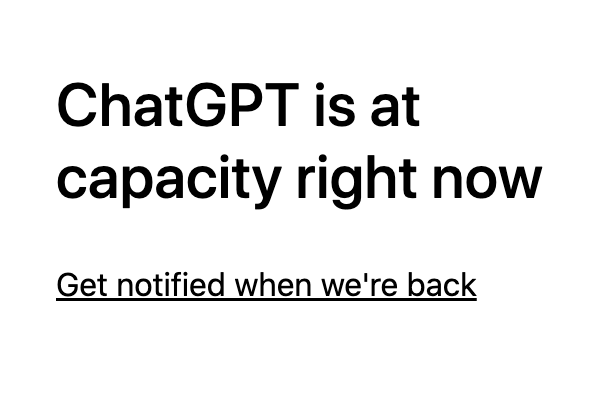
About halfway through this piece I had the notion of illustrating this concept by asking ChatGPT for help in this essay’s composition, but alas, the service is not currently available – it’s overwhelmed by demand. That’s a huge opportunity for OpenAI, the service’s owner, and I doubt ChatGPT is going to end up a fad like Clubhouse or 99 percent of crypto. I think it’s got legs, because all of us, whether we’re professionals or not, could use someone smart whispering in our ear as we compose. We may even find new kinds of writing through the relationships we cultivate with services like ChatGPT, just as we will find new ways of coding, making art, or making music.

There is something special about how we humans create works like essays or  a piece of music. It’s uniquely a product of how we think, and no other species – including machines – think quite like we do. That thought process is infinitely plastic, and will certainly incorporate tools like ChatGPT, remaining distinctly human as it does.  By extension, a piece wrought from a human intelligence has a particular effect on humans, one that can’t be recreated by any other intelligence, artificial or not. In short, we’re people, and we like stuff made by people. If ChatGPT can help us make more people-made stuff, well then, I say bring it on.

*Of course most writers would argue with my choice of the word “joy”- perhaps “ecstasy” is more appropriate, in the second Oxford sense: “an emotional or religious frenzy or trance-like state, originally one involving an experience of mystic self-transcendence.” If the writing’s going well, I certainly do lose myself  inside of it. Time is suspended,  flow is found.

** I mean “thrown” as in “shaping a pot on the wheel,” not “thrown” as in “one throws a pot against the wall in frustration.” I chose the word intentionally, considered it, and then decided to keep it. “Thrown” is a word choice that, if made by an algorithm, could prove its inhumanity – an error made by a computer. Yet when a person pushes through the obvious and into an odd timbre or slightly discordant usage, well, that can make for good writing.

***I’ve used that word “intelligences” intentionally. I’m reading James Bridle’s Ways of Being. Part of its core argument is that there are many kinds of intelligences, and more likely than not, machines already have their own. Bridle also argues – pretty persuasively – that there’s nothing particularly special about ours.


Leave a comment on ChatGPT Doesn’t Get Writer’s Block. Discuss.

Is the Most Creative Act a Human Can Engage in the Formation of a Good Question?

Wise, Kevin Kelly is.

Today I’d like to ponder something Kevin Kelly – a fellow co-founding editor of Wired – said to me roughly 30 years ago. During one editorial conversation or another, Kevin said – and I’m paraphrasing here – “The most creative act a human can engage in is forming a good question.”

That idea has stuck with me ever since, and informed a lot of my career. I’m likely guilty of turning Kevin into a Yoda-like figure – he was a mentor to me in the early years of the digital revolution. But the idea rings true – and it lies at the heart of the debate around artificial intelligence and its purported impact on our commonly held beliefs around literacy.

I’ve spent a lot of the last few decades as an interlocutor on stage or as a reporter on the ground, and I find that preparing for interviews requires not just a ton of research, but a rather formal process of interrogation of the facts prior to any actual dialog. It starts with naive, even ignorant queries, and each response yields fresh questions, each of which become more subtle, specific, and pointed. The question is the tool, it can be wielded like a spade in sand, a pick axe against stone, a paintbrush, a hex key, a hammer, a pen. It may well be the most human expression we have – our core differentiator from the stochastic parrots we can’t help but create.

All of this came rushing back to me when I read Jeff Jarvis’ post on the impact of ChatGPT on literacy. In “Writing and Exclusion,” penned prior to the New York School District banning ChatGPT, Jarvis writes “It occurs to me that we will probably soon be teaching the skill of prompt writing: how to get what you want out of a machine.” Indeed. I’d argue we’ve already been in dialog with a semi-intelligent machine for decades – ever since the dawn of search, and certainly since the rise of Google, where every interaction is considered a “query” and every response a “result.”

Back in 2005 I suggested that our schools start teaching what I then called “search literacy” – a formalized coursework to help kids understand how to ask intelligent questions of what was at the time a novel technology:

In an age where the knowledge of humankind is increasingly at our fingertips through the services of Internet search, we must teach our children critical thinking. One can never have all the answers, but if prepared, one can always ask the right question, and from that creative act, learn to find his or her own answer.

Instead, we have leaders that believe that questions have one answer, and they already know what it is. Their mission, then, is to evangelize that answer. That, to me, is a dangerous course. Reversing it by teaching our children to learn, rather than to answer, seems to me to be a noble cause.

I’m not sure any academic institution ever took me up on that call (driven, as I recall, by the Bush administration’s fixation on test scores), but Jarvis has issued an updated version of it:

…writing a prompt for the machine — being able to exactly and clearly communicate one’s desires for the text, image, or code to be produced — is itself a new way to teach self-expression.

In an age of DALL-E, ChatGPT, and large language models augmenting and/or becoming our lawyers, our lobbyists, and our programmers, perhaps it’s time to once again demand our schools teach our children how to ask interesting questions. That’s something I doubt AI will ever get right.

PS – I wanted to ask ChatGPT the question in this post’s title, but it’s clear the service is overwhelmed at the moment….

Leave a comment on Is the Most Creative Act a Human Can Engage in the Formation of a Good Question?

Writing

Time was, I sat down nearly every day of the week to contemplate a blank page – and a few hours later, more or less, I’d hit “publish” in the WordPress backend, and a few hundred (or thousand) new words would appear on this site.

It’s been a while since I’ve done that. I love writing, a process I’ve often called “thinking out loud,” and my relationship to this site was one of the most productive and important connections to the world I’ve ever had. But it’s atrophied, badly, and not a day goes by when I don’t miss it. I’m writing today not because I’ve had some insight or itch to scratch – I’ve had a million of them over the past few years, and developed an annoying habit of ignoring them all. But to be honest, I’m writing today because I can’t stand the tumbleweeds and dust bunnies dancing around this place. My email signature – the one for battellemedia.com, anyway – still has a link to this site, and this morning I considered taking it off.

Instead, I’m writing this, both a mea culpa and a promise to all of you who followed my work over the past few decades. First, the apology: I’ve met dozens of you in the past year who’ve asked me what happened to my writing, and it both pleases and pains me to hear that question. It’s something of a mystery to me why I stopped – I still write three pages a day in my personal journal, why did I fall out of practice in the public realm? Certainly my move to New York four years ago, starting another company, wrestling with my own demons as it relates to what I feel is worth paying attention to – all of that contributed. But I think in the end I just lost confidence that I had anything interesting to say. So to those of you who still believe I might, and who’ve encouraged me to start up again, I am sorry for my absence, and I will strive to make amends.

And now the promise: I’ve found myself at a place in life where I’m asking rather big questions. Our last child left for college last week, my wife and I have re-located to our family home off Cape Cod, I now commute weekly to New York, which is a situation I vastly prefer. Living in the city was invigorating but exhausting. I suppose I should have known, coming from Marin County, that the cacophony of NYC would wear me down. I’m back in a place that feels right again, and dipping in and out of New York’s mad energy allows me to keep connected, but not lose myself to the noise.   So I promise to lean back into writing on topics that interest me – regardless of whether anyone notices or responds. It’s meditative, it’s healing, and I miss the hell out of it.

I promise to be a bit more personal here, to acknowledge my ignorance and blind spots, to raise more questions than answers, and to reflect on the lessons learned over more than three decades covering tech, media and business. I also promise to answer every single one of you who reaches out, should you care to. It was just such an outreach which spurred me back to this blank screen, and to the publish button – which I’ll press now, thankful that I have the opportunity to do so. See you online.

1 Comment on Writing

A Draft Syllabus For The Rabbit Hole

(image) The most common complaint I hear from friends and colleagues who are interested in the crypto/web3 world is how hard it is to “get smart” on the topic – for a neophyte, there’s just so much noise and precious little signal. Sure, you might dive headfirst into crypto Twitter – but the experience is both jarring and unproductive (ditto that for crypto-related Discord servers).

I’ve been exploring crypto for enough time to have developed a point of view on a handful of people and resources I trust to help me make sense of what is an increasingly fractious and confusing space. Below is a first draft of what I hope will evolve into a more polished “syllabus” of sorts for smart folks interested in getting smarter. This is purposefully not complete – the list could have been much, much longer. Please comment, email, or hit me up on Twitter with additional suggestions, and I’ll incorporate them as I can. And one caveat: I’m reading in this space with an eye toward crypto’s impact on tech, society, and governance. This list is *not* created with an eye toward investing in either currencies or NFTs. There’d be an entirely different set of resources for that task!

Most of these resources are newsletters – I’m a newsletter fanatic. The ones below I almost always open when they land in my in box.

Cobie

The trend of pseudonyms is strong in crypto, and Cobie, whose real name – I think –  is Jordan Fish, is yet another example. His essays are dense, cogent, and much praised in crypto circles. I’m particularly fond of his recent post “Wtf is web3“.

Jarrod Dicker

Jarrod is something of a unicorn in the media/crypto/VC space, in that he’s a recent operator at a high level (WashPo, HuffPo), a founder in the crypto space (Po.et), a respected writer on media/web3 (his Darkstar Mirror site is a must read), and now a major force in investing as lead of crypto for TCG.

Messari

A respected early research firm in the space, most of the links require a subscription, but have good info before the jump. I find the roundups at the end of the daily newsletter very good as well.

Li Jin

I’m relatively new to Jin’s writing  – but she’s been a force in the VC world for some time. This piece, with Katie Parrott, is a fine example of her work, which tends to be accessible to new folks in the space.

Packy McCormick

This guy is the deep dive guru for startup analysis, and he’s gone all the way down the rabbit hole on crypto/web3 in the past year or so. It takes A LOT to get through his sometimes 5-10,000 word pieces, but I grok all of them, and read many. Favorites: The Laboratory for Complex Problems, Discord, Imagine a PlaceStatus Monkeys, The Great Online Game. Oh and like so many writers, he’s started a VC fund as well.

Vitalik Buterin

Dude’s the godfather of Ethereum, so everyone watches what he says. Follow him on Twitter, he posts his essays there.

Balaj Srinivasan

Srnivasan is perhaps the most evangelical and articulate of the crypto power elite. I don’t agree with a lot of his philosophy, but he’s very smart and a must read/listen (worth searching for his name in your favorite podcast app).

The Generalist

This multi-author newsletter is not all about crypto, but it’s worth a perusal. I learned a lot from its MetaMask deep dive.

Chris Dixon

Chris has been writing about this space for what seems forever, and was one of the first to define and popularize web3. And with his perch as point on crypto for a16z, his views matter even more.

Fred Wilson

Wilson has been blogging his thoughts as a VC forever, and he still blogs several times a week, covering a pretty broad waterfront in a folksy, short form voice. When he covers crypto/web3, where he’s an OG’s OG, everyone pays attention.

Katie Haun

Another must follow on Twitter, and worth listening to any pod she’s on. Was a lead on crypto at a16z, recently started her own fund.

Decrypt

This industry news site was started a few years back by pal and Wired OG Josh Quittner.  I use their daily newsletter as a way to navigate ongoing coverage. You might also check out CoinDesk and Coinbase’s in house organ.

Forefront

I appreciate the format of this newsletter – good summaries, good pieces. I can’t figure out what the company behind it is all about, but the links are consistently strong.

The Block

A finance/defi-focused outfit, its newsletter has good set of newsy items.

Real Vision Crypto Briefing

I don’t read this as much, as it often drives you toward a subscription product or videos I don’t have time to watch, but the news summaries and lead items are often good.

Casey Newton/Platformer

I’ve followed Casey’s work on tech since he started, lately he’s been doing a lot of good analysis on web3/crypto.

Ben Thompson

He doesn’t cover crypto that much, and he’s got his quirks, but I read Thompson’s stuff almost daily. One of the must reads on tech more broadly.

Azeem Azhar’s Exponential View

Like Thompson, Azhar has a much broader view of the world than just crypto, but he’s been focusing in on it of late. Plus, all his other stuff is great context for what’s happening beyond web3.

Will Wilkinson

For one reason: He wrote the excellent Is Crypto Bullshit? Oh, and related, don’t miss Max Read’s Is Web3 Bullshit? 

Again, if you have input on this brief list, and especially if you have additions, please add to comments!

1 Comment on A Draft Syllabus For The Rabbit Hole

Why Is The Streaming Experience So Terrible?

I wrote this for P&G’s Signal360 publication, but I thought I’d toss it up here as well. I know I’ve been very, very absent from writing for – well, for the entire pandemic. I plan to change that, but for now, here’s a mini-rant (I could have gone on forever) about the state of the television experience for us cord cutters out there. 


I can’t believe I’m about to write these words, but…I kind of miss cable TV.

Now before you pile on, I know. I’ve lost no sleep over cable’s slow demise. The consumer experience was…not great. We paid for 500 channels of dreck, but watched, on average, five of them (or something like that). Decades of regional monopoly gave cable television scant reason to innovate — resulting in legendarily bad customer service, instantly out of date hardware, and utterly inscrutable remote controls (admit it, you could never find the mute button, could you?!).

Streaming was supposed to change all that. The great unbundling meant consumers could choose which channels they wanted, and we’d all save money. Just as it did with music, technological innovation promised to reinvent a stagnant industry. We’d get all the wonderfulness of great television combined with the ease of the open internet! I for one couldn’t wait for it all to materialize.

Until it actually did. And it was…exponentially worse.

If you’re like the majority of American consumers, you probably cut the cord in the past five years. If you’re under 30, you likely never had a cord. When I dumped cable, I was instantly giddy. My $200 bill disappeared, replaced by $25 for YouTubeTV (so I could get sports and news, naturally), and a handful of $5-$10 additions — Netflix, Showtime, HBO. It was infinitely better, and less than half the cost. Sure, I had to juggle a few services, and not all of them played well with my Google Chromecast (my preferred way of getting TV programming from my phone to the big screen TV), but it was worth the effort. I was a trailblazer!

Four years’ worth of “tech innovation” later, my television experience is a nightmare melange of competing tech and media platforms, none of which play nice together, and all of which are incomplete. Oh, and the bill? It’s back at $200 again.

How’d we get here?

First off, YouTubeTV is now $65 a month. That’s some impressive price leverage! Add $5 for Apple, $18 for Netflix, $15 for HBO Max, $8 for Hulu, $11 for Showtime, $20 for MLBTV, and another $50 or so for a bunch of other channels — and, well, now I’m paying the same price for an inferior experience. Want to watch a show? First remember which service it’s on, then remember your password, then navigate an entirely non-standard user interface to find the show, then cross your fingers and hope the platform supports streaming to your device of choice. If it doesn’t, you might just end up watching the show on your phone. ON A PHONE!

And don’t get me started on those “smart TVs.” LG, Sony, Samsung, Google, Vizio — the whole lot of them have infected what used to be a simple piece of glass with impossibly complicated bloatware that has one goal: Locking you into their ecosystem. It’s madness.

But guess what’s even worse? Yep…the ads. Remember how streaming was supposed to make the commercials better? Tailored to your interests, unobtrusive, data-enriched? I edited a cover story for Wired about all of this — in 1994! 30 years later, our industry still hasn’t figured out how to manage reach and frequency in a connected world. And from my own experience deep in the bowels of the connected television industry, this problem won’t be fixed for a long, long time.

So let’s review: Compared to cable, streaming television has 1. A far worse user interface 2. Little to no cost advantage and 3. A far worse advertising experience — for both consumer AND advertiser. In fact, the only thing that has gotten materially better — and this is absolutely true — is the television programming itself.

So how might we fix this mess? Well, if I could wave a magic wand, I’d start by creating an open, neutral protocol to which all streaming services adhered. This protocol would allow any and all streaming services to bundle their content with their business model (subscriptions, advertising, distribution policies, and the like). Anyone could then take that protocol and build what I call a “meta service” around it. Entrepreneurs would compete to build aggregate services which solved the consumer experience problem — which by default would also solve the  marketers’ problems as well. Imagine: one place to find all your television, with one interface to rule them all. Kind of like cable used to be — but better.

We have the technology, we have the design chops, and we certainly have the content. We just need to get out of our own way. Come on, television industry: Let’s fix this mess!

3 Comments on Why Is The Streaming Experience So Terrible?

Predictions 2021: Disinformation, SPACs, Africa, Facebook, and a Return to Tech Optimism

Never in my five-plus decades has a year been so eagerly anticipated, which makes this business of  prediction particularly daunting. I’m generally inclined to be optimistic, but rose-colored glasses stretch time. Good things always take longer to emerge than any of us would wish. Over 18 years of doing this I’ve learned that it’s best to not predict what I wish would happen, instead, it’s wise to go with what feels most likely in the worlds I find fascinating (for me, that’s media, technology, and business, with a dash of politics given my last two years at The Recount). As I do each year, I avoid reading other folks’ year-end predictions (though I plan on getting to them as soon as I hit publish!). Instead, I just sit down at my desk, and in one rather long session, I think out loud and see where things land.

And off we go….

1. Disinformation becomes the most important story of the year. In some ways, this is foolhardy – like predicting that the election would drive 2020, only to see it overwhelmed by COVID-19. The topic of disinformation feels a bit cerebral and hard to pin down – not as concrete as a pandemic or an election cycle. But I’m convinced 2021 will be the year we all realize that our media/information ecosystem is broken – with disinformation, propaganda, and brazen falsehood its most pernicious externality. Businesses are waking up to the threat this  poses to their bottom lines (and to society at large), most scholars and policymakers are already there. In the words of former Republican strategist Steve Schmidt, speaking on a recent Recount podcast: “In a society where there is no ability to distinguish between the truth and the lie, democracy will be lost.” 2021 will be a year where we search for the root causes of our failures over the past few years, and at the center of that failure is a communication system that mindlessly manufactures disinformation. A free and open democratic economy can’t run on bullshit. I’m personally devoting 2021 to exploring how we can navigate the collision of technology platforms, unfettered capitalism, broken media models, and feckless regulatory oversight. More on that soon…

2. Facebook’s chickens come home to roost. Related to #1, yes, and it’s certainly passé to beat up on Facebook. As an OG in the space (“Facebook Can’t Be Fixed,” et al), I’m reluctant to go there once more – our troubles are bigger than one company alone. And for years the company has steamed ever forward, its fortunes unaffected by endless cycles of bad PR. But in 2021, the good ship Facebook will start taking on serious water. Incoming President Joe Biden will set the tone with his distaste for the company, and company’s tone deaf approach to communications will finally fail to deliver the company a pass. (If you missed it, you must watch this insanely scripted game of dodgeball between journalist Tamron Hall and Facebook COO Sheryl Sandberg). The company’s own employees are increasingly uncomfortable with their leadership, and its consumers and marketing partners are increasingly looking for alternatives to a platform they see as toxic and unwilling to change. Toss in policymakers’ thirst for an easy target and a media industry tired of the doubletalk, false narratives, and outright lies, and 2021 will be a dismal year for Facebook – in particular in the United States, where the company will likely admit that it has failed to grow user engagement. And that, to put a fine point on it, will tank the stock, full stop.

3. AI has a mid-life crisis. The past few years have witnessed the shining resurgence of artificial intelligence – breakthrough after breakthrough has led to justifiable optimism that AI-driven innovation will solve both the mundane (Look! It can untangle corporate supply chains!) as well as the divine (Look! It can cure every disease known to humankind!). All of this and more is likely true, but humanity has yet to fully comprehend the potential negative externalities of AI, much less mitigate them. Chastened by our last bout with externality ignorance (see Facebook, above), 2021 will be the year society takes a step back and thinks hard about where this is all going. Setting up the narrative is Google’s mishandling of its relationship with leading AI critic Timit Gebru, but by year’s end, the AI narrative will be as much about hand wringing and regulatory oversight as it is about revolutionary breakthroughs.

4. Then again, a wave of optimism around tech-driven innovation takes root. This is the counter narrative to five-plus years of a “tech as bogeyman” trope. 2021’s optimism will be driven by two major factors: First, a belief that we’re on a path to correct the worst mistakes of the past decade (see #1 – #3 above). And second, a slew of long-developing and real world proofs that technology-driven breakthroughs will bring serious benefits to society at scale. Candidates include biotech and bioinformatics (the core technologies behind the COVID vaccine), blockchain (though I’m certain bitcoin will have at least one of its several crashes this year), and lithium batteries (giving us hope on climate change and driving my otherwise random prediction on gas-powered cars, below).

5. Google does in 2021 what I predicted it would in 2020. And what was that? That Google zags. I wrote: “Saddled with increasingly negative public opinion and driven in large part by concerns over retaining its workforce, Google will make a deeply surprising and game changing move in 2020.” I think this is even more likely given Google is fighting off a terrifying array of massive regulatory actions, and desperately needs to avoid looking like Facebook in the eyes of its employees, consumers, and business partners.

6. Nothing will get done on tech regulation in the US. Blame antitrust. Whether or not Biden decides to continue Trump’s FTC and DOJ actions, he will likely start his own, and keep the focus on antitrust, rather than more thoughtful legislation around disinformation, machine readable data portability, or privacy. There will be some movement – net neutrality will probably get reaffirmed and we’ll fix Trump’s H1-B messes, for example. But by year’s end folks will realize that antitrust suits are essentially kabuki, an exercise designed to go nowhere and maintain the status quo. When Facebook is aggressively calling on Washington to regulate the Internet, you know they’ve done the math and concluded nothing is really going to change. Everyone’s talking about how it’s about time for the government to step up and do something, but I’m deeply cynical about anything changing in 2021. That doesn’t mean we won’t (or shouldn’t) make progress…just that it won’t happen in a year.

7. A “new” social platform breaks out in 2021. I’ve made versions of this prediction in the past, but my timing was off. Given the handcuffs 2021 will place on the traditional players in Big Tech, this coming year presents a perfect opportunity for a breakout player to redefine the social media category. There’s plenty of VC money ready to invest here, and both Tik Tok and Snap  have had their moments in the sun. It won’t be some ripoff version of what already exists (sorry, Parler). I’d either look to something like an evolved Signal, an app that already has a growing user base, or a from-nowhere startup that gets super hot, super fast because it’s fundamentally rethought social media’s traditional, serotonin-driven models for engagement and advertising .

8. The markets take a breather, and SPACs get a bloody nose. Back in 1987 I was a cub reporter covering the technology industry. One of the first stories I ever wrote involved a software startup run by a fellow I immediately judged to be a hustler. In our initial interview, he laid out how he was going to use financial engineering to take his small company public via a shell company. It struck me as dodgy then, and it strikes me as dodgy now. I have plenty of industry pals who are involved in SPAC mania now, and as far as I can tell, they’re on the up and up. SPACs can be a healthy and innovative approach to financing companies. But alas, this SPAC trend stinks of easy money and honeytraps for unsophisticated investors and shady operators. So in 2021, SPACs will lose their luster, driven in large part by several spectacular failures (or worse). Related, overall stock markets won’t crash, but by year’s end, they’ll sputter as tech stocks fall out of favor and society begins to realize how much debt needs to be worked through before true growth can reassert itself.

9. 2021 will be prove to be the last year of growth in gas-powered automobiles. There, I did it – I wrote a prediction I wish for, rather than one I can back up with my own lived experience. That said, the aforementioned breakthroughs in lithium battery technology will lead to a wave of new options for vehicle buyers, and in the long lens of history, the early 2020s will be celebrated as the period where we finally overcame our addiction to burning fossil fuels. Please, MAKE IT SO.

10. Africa rising, China…in question. A few years ago, I predicted China was going to crash, but I now realize the world needs China to counter US hegemony. With that in mind, the breakout continent of 2021 will be Africa, home to many of the fastest growing countries in the world, and the focus of years of Chinese investment and diplomacy. After four years of US neglect, the Biden administration will realize it’s dangerously close to losing Africa altogether, and announce a massive investment in the continent. Biden’s China policy will be fascinating to watch, but I’d not wager a cent on where it lands this year.

11. Everyone loses their shit, in a good way. Because we deserve one big ass party, damnit, when this pandemic finally lifts. This is the easiest one to predict, because, well….I’ll be right there with you. Until then, folks, stay safe, wear a f*cking mask when in public, and do what you can to help others get through what is still a dark damn time in our history. See you on the other side.


Previous predictions:

Predictions 2020

2020: How I Did

Predictions 2019

2019: How I did

Predictions 2018

2018: How I Did

Predictions 2017

2017: How I Did

Predictions 2016

2016: How I Did

Predictions 2015

2015: How I Did

Predictions 2014

2014: How I Did

Predictions 2013

2013: How I Did

Predictions 2012

2012: How I Did

Predictions 2011

2011: How I Did

Predictions 2010

2010: How I Did

2009 Predictions

2009 How I Did

2008 Predictions

2008 How I Did

2007 Predictions

2007 How I Did

2006 Predictions

2006 How I Did

2005 Predictions

2005 How I Did

2004 Predictions

2004 How I Did

2 Comments on Predictions 2021: Disinformation, SPACs, Africa, Facebook, and a Return to Tech Optimism

So I’m Going to China Saturday. That Just Got Interesting.

So yes, I am planning on going to China on Saturday. My first time, I’m a bit embarrassed to say. It’s not for a lack of opportunities, but rather a conviction that when I did go, I’d make a study of it, staying for at least two weeks, if not more.

But I’ve realized lately that in the past three decades of my career-related travel, I’ve never gone anywhere for more than one week. I admit, I’ve boxed China out, because I assigned it such import, such gravitas, that I needed to justify the 15-hour flight (and its attendant biome and geospatial shock) with a commitment of time I was never able to make.

So this year, I said fuggit. I’ll go when I can go, and for however long I can go. Dip a toe, go longer later. That’s my new approach. China has been looming at the edges of my self-imposed myopia for too long; plus my kids all speak Mandarin and have traveled there frequently. WTF is wrong with me?

So six or so months ago I received, and subsequently accepted, an invitation from a partner of mine, Club de Madrid, to participate in a conference in Guangzhou. The topic could not be more newsworthy: “Advancing Reform and Opening Up: Promoting Win Win Cooperation.” I mean….Win Win? China and the US?! Right?

The plan was to come in a day before, so as to get my jet-lagged shit together, and to leave the day after, so as to be truly in true gonzo form by the time I hit my daughter’s Intermezzo concert back in New York on Weds.

But then…this. The arrest of the CFO of a major Chinese technology company is jaw dropping, both objectively, given what’s going on geopolitically, as well as from my limited and admittedly self-centric point of view. A senior executive of one of the most powerful and important companies in the Chinese data economy – who happens also to be the daughter of the company’s founder– detained in Canada at the behest of the United States. Yeah, I kind of don’t care what the arrest was for (Iranian sanctions, FWIW). This is …A. Big. Fucking. Deal.

Let’s put this another and arguably more cynical way. The Trump administration is playing high stakes poker with China so as to divert attention from its domestic dumpster fires (um, Mueller, for those not playing along at home), and it’s using  the Chinese technology industry as a convenient and utterly defensible foil.

Because let’s be honest. It’s beyond believable that a company like Huawei might be in the thrall of the Chinese government. If you think that’s not a defensible statement, well, please leave your comments below, because I’ve no heard anyone I respect who studies China say otherwise.

So the stage is set.

And, by the way, why did Canada do Trump’s dirty work? That’s certainly outside the scope of my ramblings, but well worth investigation. Suffice to say, a scion of global capitalism is now in jail for geopolitical crimes, a first in the modern history of the western hemisphere, as far as I can tell. That she’s Chinese, and in Canada? Icing, folks, icing.

So this move could have been played at any time, but it’s simply perfect that it’s been rolled out now, just as the China trade tariff war has come to a boil, just as the stock markets, so beloved as a symbol of our president’s success, have been tanked by the uncertainty of the global deal between Chinese totalitarian capitalism and…well what now do we properly call the US version (Facebook capitalism? Nah. Google? Um, no. Amazon? Let’s try again….And Apple? Well, that’s complicated…Let’s just say coal capitalism, shall we! Yes, that’s it, coal!)

All of this is worth many more ponderings, and much more thinking out loud. Regardless, one thing I’m certain of: There won’t be a single senior US technology executive going to China for the next week or two, if not longer. And I’m sure simply publishing this piece will lower my odds of boarding a flight this weekend, but I must ask, out loud: Given the facts of today, would you travel to China on Saturday?

Asking for a friend.


3 Comments on So I’m Going to China Saturday. That Just Got Interesting.