Since I posted my call to action last week, nearly 600 folks have raised their hands and told me they’re reading this site via RSS. That’s pretty good, given my actual request was buried under 500 words of rambling conjecture, and my Disqus commenting system went down for portions of the first day. Not to mention, my RSS feed has grown by about 90% since the last time I posted the request, yet the number of comments (plus Tweets and other responses) was three times higher. It was the most comments I’ve ever gotten on any post, period.
So I think it’s fair to say the call was answered (we missed the overall number by about 85 votes, but there’s still time). For at least a very vocal minority of readers, RSS is still a critical tool. But, reading through the comments, it’s clear RSS has major issues, and that no one is really expecting those issues to get resolved. Most of you depend on Google Reader, and feel like the Google+ integration has been a step backward. And those of you who are publishers feel like Feedburner (also a Google product) is neglected and untrustworthy, and that there are simply no good monetization tools.
But a ton of you thanked me for making my feed full text, and I won’t be stopping that anytime soon. Thanks all, and if you haven’t left a comment on the original thread, please do! If we get to 664, I’ll feel somehow more complete!
About 14 months ago, I responded to myriad “RSS is Dead” stories by asking you, my RSS readers, if you were really reading. At that point, Google’s Feedburner service was telling me I had more than 200,000 subscribers, but it didn’t feel like the lights were on – I mean, that’s a lot of people, but my pageviews were low, and with RSS, it’s really hard to know if folks are reading you, because the engagement happens on the reader, not here on the site. (That’s always been the problem publishers have had with RSS – it’s impossible to monetize. I mean, think about it. Dick Costolo went to Twitter after he sold Feedburner to Google. Twitter! And this was *before* it had a business model. Apparently that was far easier to monetize than RSS).
Now, I made the decision long ago to let my “full feed” go into RSS, and hence, I don’t get to sell high-value ads to those of you who are RSS readers. (I figure the tradeoff is worth it – my main goal is to get you hooked on my addiction to parentheses, among other things.)
Anyway, to test my theory that my RSS feed was Potemkin in nature, I wrote a December, 2010 post asking RSS readers to click through and post a comment if they were, in fact, reading me via RSS. Overwhelmingly they responded “YES!” That post still ranks in the top ten of any post, ever, in terms of number of comments plus tweets – nearly 200.
The “Recommend this on Google” hover box at the bottom is new, I’ve never seen it before (then again, my ads are usually from FM). It’s what we in the biz call a “social overlay” or a “social ad” – and as far as I can tell, it’s only available to those advertisers who use Google AdSense.
(image is a shot of my copy of the first Wired magazine, signed by our founding team)
I just read this NYT piece on the United States’ approach to unmanned warfare: Do Drones Undermine Democracy?. From it:
There is not a single new manned combat aircraft under research and development at any major Western aerospace company, and the Air Force is training more operators of unmanned aerial systems than fighter and bomber pilots combined. In 2011, unmanned systems carried out strikes from Afghanistan to Yemen. The most notable of these continuing operations is the not-so-covert war in Pakistan, where the United States has carried out more than 300 drone strikes since 2004.
Now, it didn’t catch my eye because of its subject – Causes – but because of what its subject was doing: refocusing its business back out on the Independent Web, from its original home in the zoological garden that is the Facebook platform.
It’s been a while since I’ve posted a book review, but that doesn’t mean I’ve not been reading. I finished two tomes over the past couple weeks, Ray Kurzweil’s The Singularity Is Near, and Stephen Johnson’s Where Good Ideas Come From. I’ll focus on Kurzweil’s opus in this post.
Given what I hope to do in What We Hath Wrought, I simply had to read Singularity. I’ll admit I’ve been avoiding doing so (it’s nearly six years old now) mainly for one reason: The premise (as I understood it) kind of turns me off, and I’d heard from various folks in the industry that the book’s author was a bit, er, strident when it came to his points of view. I had read many reviews of the book (some mixed), and I figured I knew enough to get by.
I was wrong. The Singularity Is Near is not an easy book to read (it’s got a lot of deep and loosely connected science, and the writing could really use a few more passes by a structural editor), but it is an important one to read. As Kevin Kelly said in What Technology Wants, Kurzweil has written a book that will be cited over and over again as our culture attempts to sort out its future relationship to technology, policy, and yes, to God.
I think perhaps the “weirdness” vibe of Kurzweil’s work relates, in the end, to his rather messianic tone – he’s not afraid to call himself a “Singulatarian” and to claim this philosophy as his religion. I don’t know about you, but I’m wary of anyone who invents a new religion and then proclaims themselves the leader of it.
That’s not to say Kurzweil doesn’t have a point or two. The main argument of the book is that technology is moving far faster than we realize, and its exponential progress will surprise us all – within about thirty years, we’ll have the ability to not only compute most of the intractable problems of humanity, we’ll be able to transcend our bodies, download our minds, and reach immortality.
Or, a Christian might argue, we could just wait for the rapture. My problem with this book is that it feels about the same in terms of faith.
But then again, faith is one of those Very Hard Topics that most of us struggle with. And if you take this book at face value, it will force you to address that question. Which to me, makes it a worthy read.
For example, Kurzweil has faith that, as machines get smarter than humans, we’ll essentially merge with machines, creating a new form of humanity. Our current form is merely a step along the way to the next level of evolution – a level where we merge our technos with our bios, so to speak. Put another way, compared to what we’re about to become, we’re the equivalent of Homo Erectus right about now.
It’s a rather compelling argument, but a bit hard to swallow, for many reasons. We’re rather used to evolution taking a very long time – hundreds of generations, at the very least. But Kurzweil is predicting all this will happen in the next one or two generations – and should that occur, I’m pretty sure far more minds will be blown than merged.
And Kurzweil has a knack for taking the provable tropes of technology – Moore’s Law, for example – and applying them to all manner of things, like human intelligence, biology, and, well, rocks (Kurzweil calculates the computing power of a rock in one passage). I’m in no way qualified to say whether it’s fair to directly apply lessons learned from technology’s rise to all things human, but I can say it feels a bit off. Like perhaps he’s missing a high order bit along the way.
Of course, that could just be me clinging to my narrow-minded and entitled sense of Humanity As It’s Currently Understood. Now that I’ve read Kurzweil’s book, I’m far more aware of my own limitations, philosophically as well as computationally. And for that, I’m genuinely grateful.
Last week I spent an afternoon down at Facebook, as I mentioned here. While at Facebook I met with Blake Ross, Direct of Product (and well known in web circles as one of the creators of Firefox). Talk naturally turned to the implications of Google’s controversial integration of Google+ into its search results – a move that must both terrify (OMG, Google is gunning for us!) as well as delight (Holy cow, Google is breaking its core promise to its users!).
Turns out Ross had been quite busy the previous weekend, and he had a little surprise to show me. It was a simple hack, he said, some code he had thrown together in response to the whole Google+ tempest. But there was most certainly a gleam in his eye as he brought up a Chrome browser window (Google’s own product, he reminded me).
Blake had installed a bookmarklet onto his browser, one he had titled – in a nod to Google’s informal motto – “Don’t be evil.” For those of you who aren’t web geeks (I had to remind myself as well), a bookmarklet is “designed to add one-click functionality to a browser or web page. When clicked, a bookmarklet performs some function, one of a wide variety such as a search query or data extraction.”
When engaged, this “Don’t be evil” bookmarklet did indeed do one simple thing: It turned back the hands of time, and made Google work the way it did before the integration of Google+ earlier this month.
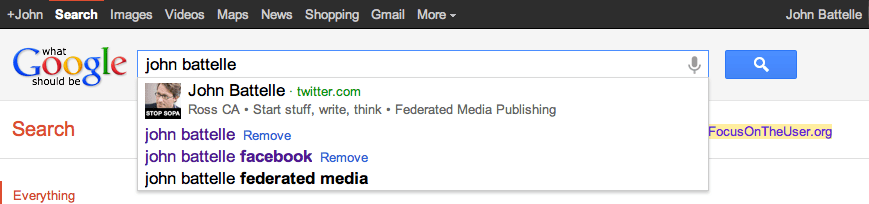
It was a very elegant hack, more thoughtful than the one or two I had seen before – those simply took all references to Google+ out of the index. This one went much further, and weaved a number of Google’s own tools – including its “rich snippet” webmaster tool and its own organic search listings, to re-order not only the search engine results, but also the results of the promotional Google+ boxes on the right side of the results, as well as the “typeahead” results that now feature only Google+ accounts (see example below, the first a search on my name using “normal Google” and then one using the bookmarklet).
After Blake showed me his work, we had a lively discussion about the implications of Facebook actually releasing such a tool. I mean, it’s one thing for a lone hacktivist to do this, it’s quite another for a member of the Internet Big Five to publicly call Google out. Facebook would need to vet this with legal, with management (this clearly had to pass muster with Mark Zuckerberg), and, I was told, Facebook wanted to reach out to others – such as Twitter – and get their input as well.
Due to all this, I had to agree to keep Blake’s weekend hack private till Facebook figured out whether (and how) it would release Ross’s work.
Today, the hack goes public. It’s changed somewhat – it now resides at a site called “Focus On The User” and credit is given to engineers at Facebook, Twitter, and Myspace, but the basic implication is there: This is a tool meant to directly expose Google’s recent moves with Google+ as biased, hardcoded, and against Google’s core philosophy (which besides “don’t be evil,” has always been about “focusing on the user”).
Now, this wasn’t what I meant last week when I asked what a Facebook search engine might look like, but one can be very sure, this is certainly how Facebook and many others want Google to look like once again.
From the site’s overview:
We wanted to see how much better social search could be for consumers if Google chose to use all of the information already in its index. We think the results speak for themselves. Specifically, we created a bookmarklet that uses Google’s own relevance measure—the ranking of their organic search results—to determine what social content should appear in the areas where Google+ results are currently hardcoded. That includes the box on the right; the typeahead; and the indent under the first result for brand searches like “Macy’s” or “New York Times”.
All of the information in this demo comes from Google itself, and all of the ranking decisions are made by Google’s own algorithms. No other services, APIs or proprietary data stores are accessed.
Facebook released a video explaining how the hack works, including some rather devastating examples (be sure to watch the AT&T example at minute seven, and a search for my name as well), and it has open sourced the codebase. The video teasingly invites Google to use the code should it care to (er…not gonna happen).
Here’s an embed:
It’d be interesting if millions of people adopted the tool, however I don’t think that’s the point. A story such as this is tailor made for the Techmeme leaderboard, to be sure, and will no doubt be the talk of the Valley today. By tonight, the story most likely will go national, and that can’t help Google’s image. And I’m quite sure the folks at Facebook, Twitter, and others (think LinkedIn, Yahoo, etc) are making sure word of this exemplar reaches the right folks at the Federal Trade Commission, the Department of Justice, Congress, and government agencies around the world.
Not to mention, people in the Valley do care, deeply, about where they work. There are scores of former Google execs now working at Twitter, Facebook, and others. Many are dismayed by Google’s recent moves, and believe that inside Google, plenty of folks aren’t sleeping well because of what their beloved company’s single-minded focus on Google+. “Focus on The User” is a well-timed poke in the eye, a slap to the conscience of a company that has always claimed to be guided by higher principles, and an elegant hack, sure to become legend in the ongoing battle of the Big Five.
As I’ve said before, I’m planning on spending some time with folks at Google in the coming weeks. I’m eager to understand their point of view. Certainly they are playing a longer-term game here – and seem willing, at present, to take the criticism and not respond to the chorus of complaints. Should Google change that stance, I’ll let you know.
We aren’t very far into the year, and signs of this coming true are all around. The “Occupy” movement seems to have found a central theme to its 2012 movement around overturning “the corporation as a person,” and some legislators are supporting that concept.
We’ll see if this goes anywhere, but I wanted to note, as I didn’t fairly do in my prediction post, the role that “The Corporation” played in my thinking. I finally watched this 2003 documentary over the holidays. Its promoters still maintain an ongoing community here, and it doesn’t take long to determine that this film has a very strong, classically liberal point of view about the role corporations play in our society.
If you can manage the film’s rather heavy handed approach to the topic, you’ll learn a lot about how we got to the point we’re at with the Citizens United case. Obviously the film was made well before that case, but it certainly foreshadowed it. I certainly recommend it to anyone who wants the backstory – with a healthy side of scare tactics – of the corporation’s rise in American society.
But while there’s probably much to say about the earnings call – in particular whether Google’s core CPC business is starting to erode (might that be due to Facebook, Wall St. wonders?) – I’m more interested in Google’s jihad against samesaid competitor, a jihad called Google+.
And in the earnings call, Google+ was identified as one of the shining stars of the quarter.
Here’s a quote from the press release, the very first quote, attributed to Larry Page. I’ve highlighted the parts where Google+ is mentioned.
“I am super excited about the growth of Android, Gmail, and Google+, which now has 90 million users globally – well over double what I announced just three months ago. By building a meaningful relationship with our users through Google+ we will create amazing experiences across our services.”
You getting that? The lead quote had to do with Google+, pretty much, not the company’s earnings, which ended up being a miss (Google is blaming fluctuations in foreign currency for much of that, and I have no idea whether that’s true, false, or silly).
But here’s my question: When is Google going to release actual engagement numbers for Google+? Because in the end, that’s all that really matters. As I have written in the past, it’s pretty easy to get a lot of people signing up for Google+ if you integrate it into everything Google does (particularly if you do it the way they’ve done it with search).
But can you get those folks to engage, deeply? That’d be a real win, and one I’d give full credit to Google for executing. After all, it’s one thing to get the horse to water…another to have it pull up a chair and share a few stories with friends.
Now, Page did talk about engagement in his comments today, but as far as I can tell, it was not specific to Google+ (though it was crafted to be easily conflated, and in reports I’ve seen across the web, it has been). He certainly led with Google+, but this is what he said:
“Engagement on + is also growing tremendously. I have some amazing data to share there for the first time: +users are very engaged with our products — over 60% of them engage daily, and over 80% weekly.”
Er….so you’re saying the folks who use Google+ use *Google* a lot. That’s not surprising – most of them came to Google+ because they were already using Google a lot. But what about minutes per month usingGoogle+? I’m guessing if Google had good news on that particular front, they’d be trumpeting it in a more direct fashion.
Look, I’m being critical here, and perhaps unfairly. But like many others, I’m a bit baffled by Google’s moves last week around search integration, and I’m looking forward to Google addressing the mounting criticism from not only its competitors, but its fans as well. So far, the company has decided to ignore it – both in its earnings calls, and in my own communications with company representatives. That only leads to speculation that Google is doing this on purpose, to get to critical mass with G+ before, cough cough, apologizing a month or so down the line and “fixing” the approach it’s taken to search integration.
I’m going to be down there soon, talking to key execs in search and, I hope, at Google+. There are always more sides to the story than are apparent as that story develops. Stay tuned.

 Since I posted my call to action last week, nearly 600 folks have raised their hands and told me they’re reading this site via RSS. That’s pretty good, given my actual request was buried under 500 words of rambling conjecture, and my Disqus commenting system went down for portions of the first day. Not to mention, my RSS feed has grown by about 90% since the last time I posted the request, yet the number of comments (plus Tweets and other responses) was three times higher. It was the most comments I’ve ever gotten on any post, period.


 by Sherry Turkle (
 by James Gleick (
 by Steven Levy (
 by Jonathan Zittrain (
 by George Friedman (
 by Michio Kaku (