
As I work on the book, I’ve come to use a shorthand for five companies that I’ve determined are critical drivers of what kind of society we’ll be living in one generation from now. At the moment I’m focused on just Internet companies, though I also plan on looking at other categories, such as energy, food, and health.
My terminology has evolved in the past week from “the Five Horsemen” to simply “The Big Five.” I’ve got a few reasons for this. First, the Horsemen analogy is a bit negative (given it evokes the Four Horsemen of Apocalypse). Second, there’s a rather fun reference for the “big five” that has to do with personality traits (see this research, or this, for example). One goal of my book, which I should probably explain at a later date, is to tease out the essential character and philosophy – perhaps you could call it the personality – of each of these key Internet players. If corporations are people (in the US, anyway), I wonder what kind of people these companies might be?
I don’t think you’ll be surprised by my choice of the Big Five, but I do hope you’ll find my reasoning for their selection worthy. As you can see from the chart, the five are: Apple, Microsoft, Google, Amazon and Facebook.
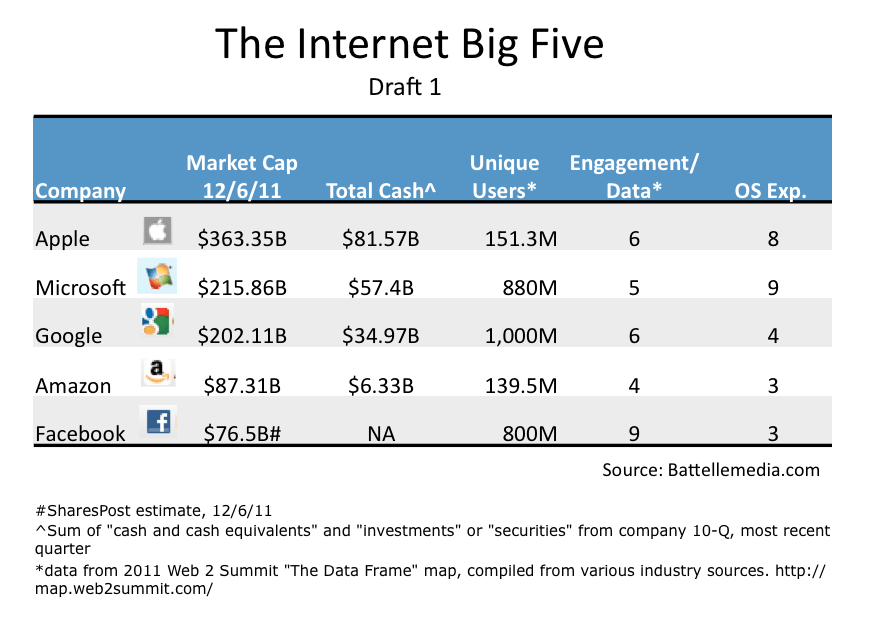
If you’re wondering if these companies are in some kind of order, the answer is yes. They are in order of current market cap (Facebook is a private market cap, the company is rumored to soon to be public at a valuation that would place it ahead of Amazon). But there’s more to the selection of this Big Five than just market cap. In fact, there are four main criteria for making it into the Big Five.
First, as I began to describe above, the companies must have financial heft, both in terms of large equity capitalizations, significant cash on hand, and a defensible core profit making machine. This gives them the ability to throw their weight around: they can make strategic acquisitions (like Google’s acquisition of Motorola), and they can leverage their profit centers and cash positions in any number of ways that offer them flexibility to play the corporate game at the very highest levels.
Second, the companies must have scale in terms of direct reach to consumers. By this I mean their brands are used as meaningful platforms by hundreds of millions of people on a frequent basis.
Third, the companies must have deep engagement with those consumers, the kind of engagement that builds brand and creates massive stores of useful data. The relationship between the brand and its customer has to be meaningful and consistent (therefore creating permission to extract a premium and offer new products and services). It takes an ongoing service relationship for such engagement to occur – Microsoft with Xbox or Windows, for example, or Facebook with its core service. On the chart, I’ve ranked engagement and data on a scale of one to ten, based in part on my work on the Web 2 map earlier this year, and partly on my own experiences. (As with other parts of this chart, I ask for your help in codifying this metric, should you be so inclined.)
Fourth, the companies must have significant experience building platform operating systems that are defensible and supported by a vibrant developer community.
The Big Five play in each of these four categories, but there are significant differences between them all, as the chart illustrates. Let’s look at each in turn:
Apple has the strongest financial position of any of the Big Five, quite a feat when you consider the company was essentially bankrupt just 14 years ago. It’s one of the top three companies in the world by market cap, and has the largest cash position of any technology company, period. Its core profit driver is its device business, which may be under attack (from Android and others), but appears defensible. Through its Macintosh and iOS platforms, it reaches hundreds of millions of consumers on a daily basis, not to mention the millions who circulate through its retail stores and various software applications. Apple has a deeply engaged set of core users, but I’ve given the company a score of 6 because a lot of the engagement which occurs with Apple’s brand and products is indirect – I’m using a Macintosh to prepare this post, but I’m not directly engaged with Apple’s products as I do it. I’m using services that layer on top of them. I’d argue this is less true with iTunes, the iPad and the iPhone, and I’d wager that’s how Apple wants it – they want to deepen engagement with their customers, and iOS is how they are going about doing that. What data Apple collects is not easy to find – but it certainly has to be deep. And Apple has long term and ongoing experience creating OS platforms, so I’ve scored the company highly there, though not as high as Microsoft, which has more reach.
Microsoft is the second strongest of the Big Five in terms of financials. While it’s certainly not been a growth stock in the past decade or so, it’s a profit machine, and its revenues are massive. Windows and Office have been consistent defensible profit centers, allowing the company to pursue search, online publishing, and gaming, among other key businesses. For the same reasons as Apple, I’ve given Microsoft a middling engagement score – its massive Windows base is not very engaged at a brand level, but the twenty-odd million folks on the Xbox Live platform certainly are. As a data powerhouse, Microsoft is a wildcard – it has not leveraged the data created by our interactions with Windows and Office – at least not in ways I can divine. It does have tons of data around Xbox, Bing, and its move to the cloud should make it a key player here soon. And when it comes to experience creating and driving developer ecosystems in the OS space, Microsoft has the deepest experience of any of the Big Five. (And no, I am not going to get into arguments of whether those OSes are better or worse than one another – for now anyway).
Google ranks third in financial heft, but its reach across the web is unmatched by any of its cohorts in the Big Five. Its search business profit center is a monster, though the company faces threats from Bing on one side, and Facebook’s social web on the other. I’ve scored Google equal to Apple in engagement – it’s clearly far stronger as an engaged brand on the Internet, but less strong in its Android business, despite Android’s larger base. And of course, Google was built from the ground up as a data machine. As for experience in operating systems and developer ecosystems, Google is still in early stages. Android and Chrome are both relatively new and not fully baked.
Amazon has never been a major hoarder of cash, but the company has been on a roll of late, and is building both its reserves and its market cap. However, its profit center – ecommerce – is arguably not as defensible as others in the Big Five (though one could reasonably argue Amazon has locked in its consumers with extremely smart services such as its recommendation engine and Prime shipping programs). The company’s reach into consumers is smaller than any of its peers in the Big Five, and it has just begun to play its device engagement hand via the Kindle platform. Of course, nearly 150mm of us are already deeply hooked into Amazon’s commerce engine, and that’s a significant data advantage. As for operating system and developer experience, let’s not forget Amazon Web Services – the compute and storage layers of what might be called the web OS. Amazon has an enviable position in these critical areas of the emerging cloud ecosystem, though they are, in the main, indirect – for now. But those services must give Amazon a view into data that is the envy of its fellow Big Five companies.
Facebook is the youngest of the Big Five, and has pretty much no publicly available financial information. It’s fair to assume it’s the weakest of the Big Five financially, but that is set to change in the next year. It already boasts a massive valuation in the private markets, and once it goes public, it could have upwards of $10billion or more to play with. It has massive reach and deep engagement – nearly 1 billion of us use the service, half of us use it daily. Facebook’s data trove is enviable, and its moves into nearly every aspect of our lives – from payment to media, will create even more of it. The company also has created a huge base of developers for its platform, but the ecosystem is incomplete compared to vertically integrated OSes like iOS, Mac or Windows. Given its youth, I’d argue Facebook has the most to prove, but certainly has earned its place in the Big Five.
I’d love your input on the Big Five. I plan to use this post as a milestone of sorts, as I begin the journey of writing about their impact on our culture in the coming generation.
I think the big 5 you highlight are accurate but it would be interesting for you to look to the next big 5. Companies that are going to be core to the big 5 maintaining and growing market share. Companies like ARM Holdings that produce low-cost, power-efficient processors. Companies like this will help narrow the technology divide and put Facebook in the hands of more people.
And I wonder how companies like Oracle would be perceived. At ~$160b market cap, it’s a decent player – buying out company after company – and there would be quite a large number of indirect users – people who don’t even know they’re using some form of Oracle product while transacting online or at work.
Good point. The Enterprise part of the equation is one I purposely kept out – otherwise HP, IBM, SAP, and others would loom large. My point is that if you want to have a direct effect on culture, you have to have a direct relationship with the “voters” – the consumers.
SNIP:
… is to tease out the essential character and philosophy – perhaps you could call it the personality … UNSNIP
If you haven’t already seen it, there’s a very revealing documentary: http://www.thecorporation.com/
about the character / nature of companies – it’s wealth worth watching the Extra Features excerpts.
Enjoy.
For sure. Thanks for the reminder!
Ben Parr observed that Apple is all about Design and Google all about Data. I added Delivery for Amazon and Discovery for Facebook. Microsoft? Dependable?
JB – totally agree (although we have focused on 4 of them, since MSFT biz units tend to be less cohesive). What we think is interesting is the Confluence in the spaces that these big companies operate in (social, commerce, info, and entertainment). More interesting is how traditional industries adapt (or die). Our post on this in BI is here: http://www.businessinsider.com/infograph-the-shifting-digital-media-landscape-2011-10
Thanks for the pointer!
It is hard not to agree and I wouldn’t change them but:
1. They are the most analyzed, the most written about – so it looks a bit boring, but maybe you have new approach to them
2. It is a US/European perspective. To large parts of the world the “personality” of these five companies would be “Successful american entrepreneurs with minor differencies”, like when we talk about “Russian oligarchs”
What can we learn from the decline of Yahoo and AOL, who just 12 years ago would have been two out of the “Big five”?
Very good points.
One more thought:
China – If you have a long-term and global view, China may well have the same journey as Japan (from nothing to Toyota) and South Korea
(Samsung). But with a much larger impact, leveraging a huge home market and easier global roll-out of tech/web services Today at least two of the Big Five, Google and Facebook, have larger Chinese competitors.
Yes, indeed. China shows up in energy and comms as a top market cap player
I started to write a comment but it grew into behemoth of one. So, I made it a blogpost: http://www.awwsullivan.com/post/13888690636/its-time-to-reinvent-the-internet.
It’s a Context War. Google and Apple are thoroughly aware of the stakes.
Amazon’s lead in cloud svcs and their high-quality UX may give them room to catch up in devices. Whoever monetizes n dimensions of each of their loyal users’ personal context, with excellent privacy, security, transparency and well-managed permissions… and SHARES the revenue, will have long-term, unprecedented lock-in.MS is only marginally in the group because of trust and reputation issues. FB may be able to overcome those issues eventually via greater flexibility, but may never bother with trust. Diagrams @ dodsworth.com.
I’d like to see you add Twitter and make it the Big 6….simply because of their global cultural impact and as a point of balance to the others. Twitter is something different and would offer a good compare and contrast point to your exposition.
I agree that Twitter is important. I call them a “free radical” in the space and am rooting for them. But they don’t meet the qualifications on financial strength or OS…
By the time your book gets published, they might meet these qualifications, no?
It might. But the others have quite a head start.
John – great post! Such a simple topic yet very few people write about it and think about it this way.
A few thoughts –
1. Amazon as it stands needs to be compared with Wal-mart, and taking away Wal-mart’s share of the retail / consumer goods business – both physical and digital. In that respect, all the other 4 have created their own industry and business online.
2. I understand how you came about the order, but recent trends of growth (or lack of) would change this up completely. I don’t think most people in the tech industry consider Microsoft to be #2.
I agree however Microsoft has far more resources.
Interestingly, Google is the only one of these that supports the Open Web. All the others are totally proprietary and want all the data they acquire for themselves. Even when they open up to the development world to share an API, Facebook and Apple seem to want to control the direction of their communities a lot more whereas Google seems more open to letting the community police itself.
If this is what the Web will look like in a generation from now, I don’t find that encouraging. I’d like to see more companies that support Open Source moving up in these ranks.
Apple did give Webkit to the world, and Microsoft has embraced open in various ways. I intend to map all this as part of the book’s research….
You list AAPL has have 150M unique users, but SJ said they had 200M unique CCs registered in iTunes. Little but more research is due I think….
For sure. THanks. We’ll update it.
John, don’t forget Amazon’s push into advertising when assessing its position; I think our efforts here are more significant in terms of “a view into data” than Amazon Web Services.
http://www.reuters.com/article/2011/12/06/us-amazon-advertising-idUSTRE7B52CK20111206
Joe, you’re right. I’d love to come up there and meet with you and others to talk further about that.
I like it….$goog is truly breaking out and data DNA is so native to them as you aptly remind.
I think trying to figure out 3 companies that could sneak up is juist as important though at this point and I will start thinking about that harder. Intuit comes to mind as no one really competes around the consumer and financial data. Its theres to lose.
Adjacencies come to mind, like Amex or Chase, GE, or IMB
Microsoft probably soon leave this p Five)
TYCLLOHHZYTQLKX
Replica Oakley Sunglasses are Awesome and Well-liked by the Young
hmm, Microsoft and Google are tearing each other to peaces. One of them or both of them is going to go.
This is a great analysis but I’m thinking it should include China’s Tencent with its market cap of $358B. Baidu would not make the top 5, but is significant at $46B. The companies on the list indeed have broad international presence but I would think the Chinese are thinking hard about how to do that too. A natural partner could be Amazon.
Good point, Mark. Thanks.
I agree with Allen Taylor that the crucial competitive advantage Google has over the other big 4 companies is the openness of their ecosystem and development platforms. I thought that the lesson had already been learned from the first implosion of Apple computers vis a vis the PC and Microsoft’s OS, that relatively closed platforms have a limited shelf life. The business that is the most porous to “crowd” sourcing its development ideas, will always prevail.
Yes, Apple have had a spectacular renaissance built on the back of game changing hardware devices, which in turn have lead to new markets for application development. However that emphasis on new hardware, is ultimately self limiting, as devices will either merge utilities, or we will reach saturation point on the number of devices we can physically carry. Either way, having already covered most bases, there is probably a limit to the amount of hardware Apple can continue to bring to market, that we can consume or even wish to master technically.
Having said all of this, I suspect the big 5 corporations are already too narrowly focused on information and data as stand alone commodities. Discuss 🙂
I read attentively your post but i could not stop to reading your blog because this is so nice and interesting post. author