Predictions 2012: #1 – On Twitter and Media

2012 is going to be a year of contrasts – of consolidation of power for the Internet Big Five, and fragmentation and disruption of that power due to both startups as well as government and consumer action. I’ve spent the past few weeks jotting down thoughts for 2012, and hope to do the Year That Is About To Be justice in the following set of posts.

Yes, I said “set of posts,” because for the first time since the birth of this blog (that’d be nine years ago), I’m going to post my predictions one by one. Why? Well, because I’d like to dig in a bit on each. If I do it all in one post, we’d have a *very* long read, and most of you are just too busy for that. I don’t plan to release these posts slowly, I’m just going to write till I’m done, so ideally I’ll be done in a few days. And when I’ve finished, I’ll post a summary of them all, for those of you who want all these predictions in one easily linkable place.

So let’s start with Prediction #1: Twitter will become a media company, and the only “free radical of scale” in our Internet ecosystem. 

Read More
18 Comments on Predictions 2012: #1 – On Twitter and Media

SIGN UP FOR THE NEWSLETTER

Stay up to date on the latest from BattelleMedia.com

Google Does Its Tenth Annual Zeitgeist

Ten years ago, Google’s first Zeitgeist inspired my first book (The Search). Here are some highlights from the tenth annual edition. Props to Google for going deeper than most year end lists with its data. Now…open source the damn data, folks!!!


5 Comments on Google Does Its Tenth Annual Zeitgeist

TextPlus Adds Free Calling – Watch This Space

A couple of weeks ago I met with the CEO of TextPlus, and wrote up my experience here. I mentioned he has some news coming, and this is it: TextPlus, which is a popular free text messaging service, is launching free calling between TextPlus members today. Calling to regular lines is pretty cheap to boot (like 99 cents for 40 minutes).

Why am I writing this up? Because it makes me wonder….TextPlus is a fast growing service that is leveraged over the Apple iOS world I call AppWorld. It serves at the whim of a gatekeeper, in this case, Apple (you can also get it for Android, which is growing faster). Apple, in turn, must keep its carriers happy by selling tons of iPhones (and iPads) with plans that lock customers into paying a pretty penny for data and voice connectivity. And I am not sure those carriers are happy with the idea of a fast growing app that helps teenagers (TextPlus’ main constituency) bypass those profitable service plans. It’s like a built in way to teach the next generation of customers how to cut the cord.

Sure, there’s always Skype and Google Hangouts and such, so perhaps this isn’t such a big deal. But then again, maybe it is. With Wifi coverage growing quickly these days, TextPlus – perhaps the name now should be CommPlus – is one to watch, IMHO.

3 Comments on TextPlus Adds Free Calling – Watch This Space

Neal Stephenson on Important Work

(image) An interesting interview in the NYT  I missed from last week, with noted author Neal Stephenson. In it, he riffs on something that’s been bugging me as I work on the book. Asked about “the future of computing,” he responds:

“I’ll tell you what I’d like to see happen,” he said, and began discussing what the future was supposed to have looked like, back in his 1960s childhood. He ticked off the tropes of what he called “techno-optimistic science fiction,” including flying cars and jetpacks. And then computers went from being things that filled a room to things that could fit on a desk, and the economy and industries changed. “The kinds of super-bright, hardworking geeky people who, 50 years ago, would have been building moon rockets or hydrogen bombs or what have you have ended up working in the computer industry, doing jobs that in many cases seem kind of ignominious by comparison.”

Again, a beat. A consideration, perhaps, that he is talking about the core readership for his best sellers. No matter. He’s rolling. He presses on.

Read More
Leave a comment on Neal Stephenson on Important Work

Instrumenting People Into Location Services

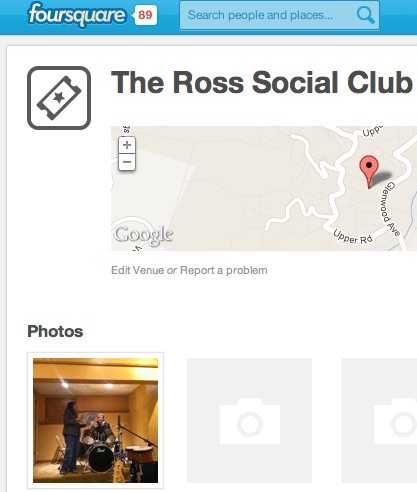
So this week a well known VC made the trek to my writing retreat in Marin, and we hung out in a room that until this year was a large storage closet behind my garage. I rethought the space, soundproofed it, added a hodge-podge of AV gear and musical instruments, and named the place the “Ross Social Club”  – on Foursquare, anyway. I haven’t really told anyone that I gave the place a name, but it was sort of an experiment – would anyone ever check in there besides me?

Now I chose that name for various reasons I won’t get into here (another story, one I’ll be glad to tell you over a bourbon). But I like being able to name a space on Foursquare, and it’s become a habit for me to “check in” whenever I actually use the room. It’s like  leaving a digital breadcrumb for me, a record of my new relationship to music (I’m learning to play the drums). A lot of friends hang out there too, often playing their own instruments or riffing on the whiteboards I’ve hung about the place. But  I don’t make it a habit to mention the room’s Foursquare doppelganger. It seems a bit … forced. And as far as I know, many of them don’t use the service.

On the same day I created the RSC on Foursquare (and probably because he asked me what I was doing on my phone), one fellow did check in. With some whimsy, he added a tip: “Try the wings.” It’d make you laugh if you’ve ever been there, trust me. Since then, in the past nine months, countless folks have been through the place, but only one other person has checked in.

Read More
9 Comments on Instrumenting People Into Location Services

Help Us Shape The Signal Conferences in 2012

I’ve spent the better part of a few days thinking through the theme(s) of FM’s Signal series of conferences for the upcoming year. I’ve got a ton of thoughts scrawled across my whiteboards, but then a thought woke me up in the middle of the night – why don’t I ask all of you what you think are the most important trends for digital marketing in 2012? (This crowdsourcing thing, it might just take off…).

So I signed up for PollDaddy and created my first ever Searchblog poll. You can pick three of the choices below, and/or add your own topic at the bottom. So help a brother out, and let me know what you think!

8 Comments on Help Us Shape The Signal Conferences in 2012

Facebook and Commenting Systems: Still Some Open Questions

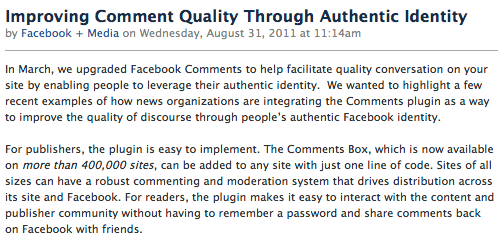
I’ve always been quite interested in commenting systems for the Independent Web, and when it came time to redesign this site, I chose to use Disqus, an independent company that is a leader in the space. Disqus has its detractors, but it has many more fans. The company has nearly 1 million sites using the services and is rolling out new features very quickly.

I did make a conscious choice to *not* use Facebook’s Commenting system. And while I could have justified the decision on pure features (I think Disqus still wins there), it’s more based on my belief in the Independent Web. I prefer to not have this valuable portion of my own domain controlled by a major identity platform with which I have some basic philosophical differences. (In short, I do not agree with the company’s stance on identity, among a few other things).

However, I was curious if others felt the same way. Apparently, the answer is no, if the numbers are any indication. Last night I asked this question on Quora: How many websites use facebook commenting? I’m curious if the service is growing, slowing, or flat?  I also emailed people I know at Facebook, and tweeted it. By this morning, Facebook gave me the answer (oddly, it did not show up on Google search, but that may because the two companies are retarded when it comes to sharing access to each other’s platforms. That’s a whole ‘nother story).

Read More
55 Comments on Facebook and Commenting Systems: Still Some Open Questions

Whisperings of the Future Surround Us

Yesterday I met with Christopher Ahlberg, the PhD co-founder of Recorded Future, a company I noted in these pages back in mid-2010. Ahlberg is one of those rare birds you just know is making stuff that matters – a scientist, an entrepreneur, a tinkerer, and an enthusiast all wrapped into one.

He ran me through Recorded Future’s technology and business model, and I found it impressive. In fact, I’m hoping I can employ it somehow into my book research. And that conditional tense of “hoping” is the main problem I have with Ahlberg’s creation – it’s a rather complicated system to use. Then again, what of worth isn’t, I suppose?

Recorded Future is, at its core,  a semantic search engine that consumes tens of thousands of structured information feeds as its “crawl.” It then parses this corpus for several core assets: Entities, Events, and Time (or Dates). Recorded Future’s algorithms are particularly adept at identifying and isolating these items, then correlating them at scale. If that sounds simple, it ain’t.

Read More
8 Comments on Whisperings of the Future Surround Us

Kevin Kelly’s “What Technology Wants”

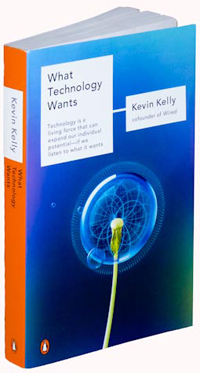
It took me a while, but I’ve finally finished Kevin Kelly’sWhat Technology Wants,” first published last year and now out in paperback. Befitting a tome that took five or so years to write, Kevin’s book is not the kind of work that is easily digested – at least for me.

But that’s not to say it’s not worthy. It most certainly is. I worked with Kevin for five wonderful years as a co-founding editor of Wired, and throughout that tumultuous period (1992-1997) Kevin never ceased to surprise me – both with stories of his extraordinary life (after converting to Christianity whilst wandering in the Middle East, for example, he bicycled across the US under the self imposed belief that he would die at the end of his trip), as well as with his boundless curiosity. I was very young when we worked together, to say he had a profound impact on how I understood the practice of writing is an understatement. Together we edited every single word in more than fifty issues of Wired, after all.

With those caveats declared, then, let me get to the book at hand. Some non-fiction books present themselves as lectures or arguments. And still others are very clearly the manifestation of the author’s own unscratchable itch. What Technology Wants is both of these, and more. In the introduction, Kevin pretty much sums it up: “What was (technology’s) essence? If I didn’t understand the basic nature of technology, then as each new piece of it came along, I would have no frame of reference to decide how weakly or strongly to embrace it.”

Read More
20 Comments on Kevin Kelly’s “What Technology Wants”

You Are The Platform

A funny thing happens to me after each Web 2 Summit – I tend to curl up for a week or two and shut down my idea receptors. It takes a ton of output to curate the show, and then running it for three straight days is rather like running an intellectual and social marathon. You’re “on” the whole time, scrambling backstage, pretending to have it together onstage, greeting amazing minds, cheering them on, delivering what I hope will be thought provoking interlocution, and, of course, remembering to thank everyone for giving so generously of their time and treasure.

So when people ask me what I thought of the show, or what the key themes were, I usually have something of a blind spot. I can remember everything up to the start of the event – all the preparation, preproduction interviews, the endless research, etc. But once we kickoff (in this case, with an interview with Sean Parker), it goes kind of black. My next memory is usually the final cocktail party on day three. I know my Dad and my wife are usually there, and I know I have a fine bourbon in my hand. And I’m happy. And I want to sleep.

Which I’ve done a lot of these past two weeks. But this last show was too rich to not review a bit, in particular for themes that should inform our collective decisions as we move our industry forward. In this post and I hope in others this Fall, I hope to outline some of those themes.

Read More
16 Comments on You Are The Platform