The Yin and Yang of Audience

(image) The Signal San Francisco conference is less than a week away, so I thought I’d take the time to explain my reasoning for the theme, and offer a curtain raiser of sorts on the day-long program. (PS, I have ten, and only ten, half price tickets available. Hit this link, and use the code “luckyday.”)

The theme, a portion of which is the title of this post, is “The Yin and Yang of Audience, Platforms and the Independent Web.” I do get a few eyes a-rollin’ when I frame conference themes, but hey, I can only do what I know how to do. I actually think pretty hard about this stuff, and like to take the time to outline the ideas behind the program.

So here goes. As readers know, I’ve been thinking out loud a lot about the future of the Internet, and whether the rise of “walled gardens” like Facebook and Apple’s iOS (what I call AppWorld) are ultimately the future the web. My short answer is yes….and. By that I mean that the Internet, which began as an open, gatekeeper-free platform where anyone could hang a shingle, will ultimately interconnect with these walled gardens – there’s just too much value in what I call the “ecosystem approach” for the opposite to occur. I framed two major forces driving the Internet today: The independent web (sites unaffiliated with major platforms like Google or Facebook), and the dependent web (major platforms which create a valuable “logged in” experience that changes “depending” on who you are.).

Read More
Leave a comment on The Yin and Yang of Audience

SIGN UP FOR THE NEWSLETTER

Stay up to date on the latest from BattelleMedia.com

CM Summit White Paper from 2007

I am in the midst of writing a post on the history of FM (update – here it is), and I thought it’d be fun to post the PDF linked to below. It’s a summary of musings from Searchblog circa 2006-7 on the topic of conversational media, which is much in the news again, thanks to Facebook. We created the document as an addendum to our first ever CM Summit conference, as a way of describing why we were launching the conference. (BTW, the Summit returns to San Francisco next week as Signal SF, check it out.)

It’s interesting to see the topics in the white paper come to life, including chestnuts like “Conversation Over Dictation,” “Platform Over Distribution,” “Engagement Over Consumption,” and “Iteration and Speed Over Perfection and Deliberation.”

Enjoy.

Read More
1 Comment on CM Summit White Paper from 2007

Facebook News (Livestream): The Brand Spaces Are Bigger, Bolder, More…Ad Like

Facebook is holding it’s first ever “fMC” today – that’s Facebook Marketing Conference, and it’s announcing widely expected new ad formats. From the release just sent to me:

Today, Facebook announced a new design for Pages, giving brands and businesses more ways to tell their story. The redesigned Pages are more personalized and complementary to the look and feel of individual profiles. Now, when you visit a Page, you can see your friends’ interactions with that Page as friend activity, making the experience more dynamic and relevant for Facebook users.

Highlights of other new features include:
· Pinned posts keep important stories at the top of a Page timeline for up to seven days.
· The new admin panel makes it easy for Page administrators to track their performance and to respond to private messages from people.
· Larger stories, milestones, and Page Timeline. The new Page design allows Page owners to tell richer stories through bigger photos and milestones that can include a date and other content.

Read More
1 Comment on Facebook News (Livestream): The Brand Spaces Are Bigger, Bolder, More…Ad Like

San Francisco In The Spring: Come To Signal

Over at the FM blog, I just posted the draft agenda for the first of five conferences I’ll be chairing as part of my day job at Federated Media. Signal San Francisco is a one-day event (March 21) focused on the theme of  integrating digital marketing across large platforms (what I’ve called “dependent web” properties) and the Independent Web. The two are deeply connected, as I’ve written here. As we explore that “interdependency,” we’ll also be talking about some of the most heated topics in media today: the role of mobile, the rise of brand-driven content, the impact of real-time bidded exchanges, and more.

Signal builds on the format I spent almost a decade crafting at the Web 2 Summit – the “high order bit,” or short, impactful presentation, as well as case studies and deeper-dive one-on-one interviews with industry leaders. Those include Jeff Weiner, CEO of LinkedIn, Adam Bain, President of Revenue at Twitter, Neal Mohan, who leads Google’s ad products, and Ross Levinsohn, who runs Yahoo! Americas, among others.

Others represented include Instagram, AKQA, Babycenter, Intel, Tumblr, WordPress, ShareThis, Facebook, and many more. I hope you’ll consider registering (the earlybird expires next week), and joining me for what’s certain to be a great conversation.

Leave a comment on San Francisco In The Spring: Come To Signal

The Internet Big Five

As I work on the book, I’ve come to use a shorthand for five companies that I’ve determined are critical drivers of what kind of society we’ll be living in one generation from now. At the moment I’m focused on just Internet companies, though I also plan on looking at other categories, such as energy, food, and health.

My terminology has evolved in the past week from “the Five Horsemen” to simply “The Big Five.” I’ve got a few reasons for this. First, the Horsemen analogy is a bit negative (given it evokes the Four Horsemen of Apocalypse). Second, there’s a rather fun reference for the “big five” that has to do with personality traits (see this research, or this, for example). One goal of my book, which I should probably explain at a later date, is to tease out the essential character and philosophy – perhaps you could call it the personality – of each of these key Internet players. If corporations are people (in the US, anyway), I wonder what kind of people these companies might be?

I don’t think you’ll be surprised by my choice of the Big Five, but I do hope you’ll find my reasoning for their selection worthy. As you can see from the chart, the five are: Apple, Microsoft, Google, Amazon and Facebook.

Read More
50 Comments on The Internet Big Five

Help Us Shape The Signal Conferences in 2012

I’ve spent the better part of a few days thinking through the theme(s) of FM’s Signal series of conferences for the upcoming year. I’ve got a ton of thoughts scrawled across my whiteboards, but then a thought woke me up in the middle of the night – why don’t I ask all of you what you think are the most important trends for digital marketing in 2012? (This crowdsourcing thing, it might just take off…).

So I signed up for PollDaddy and created my first ever Searchblog poll. You can pick three of the choices below, and/or add your own topic at the bottom. So help a brother out, and let me know what you think!

8 Comments on Help Us Shape The Signal Conferences in 2012

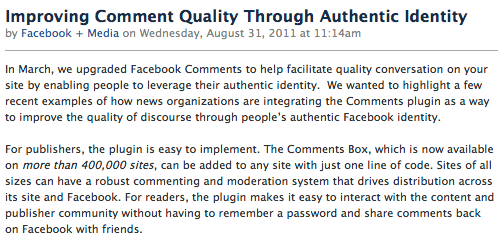
Facebook and Commenting Systems: Still Some Open Questions

I’ve always been quite interested in commenting systems for the Independent Web, and when it came time to redesign this site, I chose to use Disqus, an independent company that is a leader in the space. Disqus has its detractors, but it has many more fans. The company has nearly 1 million sites using the services and is rolling out new features very quickly.

I did make a conscious choice to *not* use Facebook’s Commenting system. And while I could have justified the decision on pure features (I think Disqus still wins there), it’s more based on my belief in the Independent Web. I prefer to not have this valuable portion of my own domain controlled by a major identity platform with which I have some basic philosophical differences. (In short, I do not agree with the company’s stance on identity, among a few other things).

However, I was curious if others felt the same way. Apparently, the answer is no, if the numbers are any indication. Last night I asked this question on Quora: How many websites use facebook commenting? I’m curious if the service is growing, slowing, or flat?  I also emailed people I know at Facebook, and tweeted it. By this morning, Facebook gave me the answer (oddly, it did not show up on Google search, but that may because the two companies are retarded when it comes to sharing access to each other’s platforms. That’s a whole ‘nother story).

Read More
55 Comments on Facebook and Commenting Systems: Still Some Open Questions

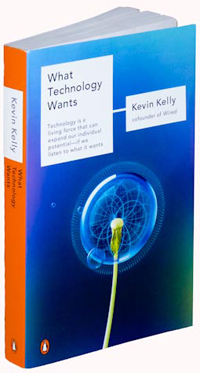
Kevin Kelly’s “What Technology Wants”

It took me a while, but I’ve finally finished Kevin Kelly’sWhat Technology Wants,” first published last year and now out in paperback. Befitting a tome that took five or so years to write, Kevin’s book is not the kind of work that is easily digested – at least for me.

But that’s not to say it’s not worthy. It most certainly is. I worked with Kevin for five wonderful years as a co-founding editor of Wired, and throughout that tumultuous period (1992-1997) Kevin never ceased to surprise me – both with stories of his extraordinary life (after converting to Christianity whilst wandering in the Middle East, for example, he bicycled across the US under the self imposed belief that he would die at the end of his trip), as well as with his boundless curiosity. I was very young when we worked together, to say he had a profound impact on how I understood the practice of writing is an understatement. Together we edited every single word in more than fifty issues of Wired, after all.

With those caveats declared, then, let me get to the book at hand. Some non-fiction books present themselves as lectures or arguments. And still others are very clearly the manifestation of the author’s own unscratchable itch. What Technology Wants is both of these, and more. In the introduction, Kevin pretty much sums it up: “What was (technology’s) essence? If I didn’t understand the basic nature of technology, then as each new piece of it came along, I would have no frame of reference to decide how weakly or strongly to embrace it.”

Read More
20 Comments on Kevin Kelly’s “What Technology Wants”

You Are The Platform

A funny thing happens to me after each Web 2 Summit – I tend to curl up for a week or two and shut down my idea receptors. It takes a ton of output to curate the show, and then running it for three straight days is rather like running an intellectual and social marathon. You’re “on” the whole time, scrambling backstage, pretending to have it together onstage, greeting amazing minds, cheering them on, delivering what I hope will be thought provoking interlocution, and, of course, remembering to thank everyone for giving so generously of their time and treasure.

So when people ask me what I thought of the show, or what the key themes were, I usually have something of a blind spot. I can remember everything up to the start of the event – all the preparation, preproduction interviews, the endless research, etc. But once we kickoff (in this case, with an interview with Sean Parker), it goes kind of black. My next memory is usually the final cocktail party on day three. I know my Dad and my wife are usually there, and I know I have a fine bourbon in my hand. And I’m happy. And I want to sleep.

Which I’ve done a lot of these past two weeks. But this last show was too rich to not review a bit, in particular for themes that should inform our collective decisions as we move our industry forward. In this post and I hope in others this Fall, I hope to outline some of those themes.

Read More
16 Comments on You Are The Platform

Brands as Publishers

This week Ad Age published All Brands Are Publishers, Learn How to Be a Good One, by yours truly. In it I summarize six or so years of work I’ve done outlining terms like “conversational media,” which I first outlined on this site, “brands as publishers,” also written about first in these pages and at FM’s home, and of course the Independent Web (again, here).

But I hadn’t really pulled all of it together in short form, till now. So give the piece a read, if you’re so inclined. It’s written for the print version, so there are no links. (Old school!). From it:

It’s illuminating to remember that five years ago, Twitter was three months old, and Facebook had just opened to non-students. Neither company had a business model. Oh, and Digg was considered the pre-eminent social news service.

Read More
13 Comments on Brands as Publishers