With Google’s 2012 Zeitgeist, You Won’t Learn Much. Why?

Guess what? This guy was big this year. Really!

I think readers know that on balance, I’m a fan of Google. I recently switched to the Nexus 4 (more coming on that front as I settle into really using it). I believe the company has a stronger core philosophy than many of its rivals. Overall, given that it’s nearly impossible to avoid putting your data into someone’s cloud, I believe that Google is probably the best choice for any number of reasons.

But that doesn’t mean I won’t criticize the company. And every year about this time, I end up doing just that.

Read More
12 Comments on With Google’s 2012 Zeitgeist, You Won’t Learn Much. Why?

SIGN UP FOR THE NEWSLETTER

Stay up to date on the latest from BattelleMedia.com

As Long As It’s Legal, Corporations Will Act Selfishly

(image) There’s a hubbub in the press this week about Google employing a “Double Irish – Dutch Sandwich” tactic to funnel profits from Europe over to Bermuda, where there is no corporate income tax. Reuters reports that the company saved around $2 billion in taxes by employing the structure, which, as far as I can tell, is perfectly legal.

Of course, there’s a difference between that which is perfectly legal and that which seems, well, unseemly. Creating multiple shell companies across four nation states so as to avoid paying taxes may make shareholders happy, but it sure has pissed off a bunch of (revenue starved) countries in the EU. The article mentions the UK, France, and Italy as all investigating Google (and Facebook, among others) for potential abuse of the tax code.

To which I must say this: What else did you expect?!

Read More
6 Comments on As Long As It’s Legal, Corporations Will Act Selfishly

Google’s Transparency Report: A Good And Troubling Thing

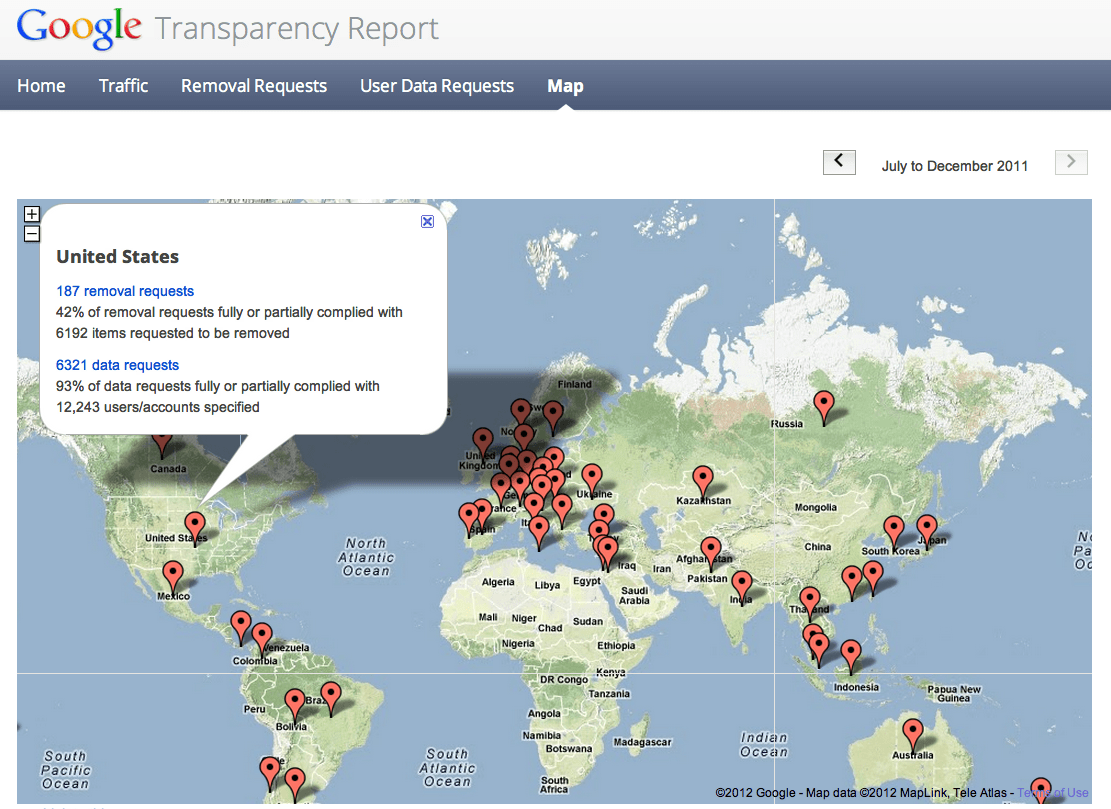
A couple of days ago Google released its latest “Transparency Report,” part of the company’s ongoing commitment to disclose requests by individuals, corporations, and governments to change what users see in search results and other Google properties such as YouTube.

The press coverage of Google’s report was copious – far more than the prior two years, and for good reason. This week’s disclosure included Google’s bi-annual report of government takedown requests (corporate and individual requests are updated in near real time). The news was not comforting.

Read More
11 Comments on Google’s Transparency Report: A Good And Troubling Thing

What Doesn’t the Valley Understand About Washington?

A few weeks ago I ventured to our nation’s capital to steep in its culture a bit, and get some first hand reporting done for the book. I met with about a dozen or so folks, including several scholars, the heads of the FCC and FTC, and senior folks in the Departments of Commerce and State. I also spoke to a lobbyist from the Internet industry, as well as people from various “think tanks” that populate the city. It was my first such trip, but it certainly won’t be my last.

Each of the conversations was specific to the person I was interviewing, but I did employ one device to tie them together – I asked each person the same set of questions toward the end of the conversation. And as I was on the plane home, I wrote myself a little reminder to post about the most interesting set of answers I got, which was to this simple question: What doesn’t the Valley understand about Washington?

It’s not a secret that the Valley, as a whole, has an ambivalent attitude toward DC. Until recently, the prevailing philosophy has trended libertarian – just stay out of the way, please, and let us do what we do best. Just about every startup CEO I’ve ever known – including myself – ignores Washington in the early years of a company’s lifecycle. Government is treated like plumbing – it’s dirty, it costs too much, it’s preferably someone else’s job, and it’s ignored until it stops working the way we want it to.

Read More
17 Comments on What Doesn’t the Valley Understand About Washington?

Architectures of Control: Harvard, Facebook, and the Chicago School

Early in Lessig’s “Code v2,” which at some point this week I hope to review in full, Lessig compares the early campus networks of two famous educational institutions. Lessig knew them well – in the mid 1990s, he taught at both Harvard and the University of Chicago. Like most universities, Harvard and Chicago provided Internet access to their students. But they took quite different approaches to doing so. True to its philosophy of free and anonymous speech, Chicago simply offered an open connection to its students – plug in anywhere on campus, and start using the net.

Harvard’s approach was the polar opposite, as Lessig explains:

At Harvard, the rules are different….You cannot plug your machine to the Net at Harvard unless the machine is registered – licensed, approved, verified. Only members of the university community can register their machines. Once registered, all interactions with the network are monitored and identified to a particular machine. To join the network, users have to “sign” a user agreement. The agreement acknowledges this pervasive practice of monitoring. Anonymous speech on this network is not permitted – it is against the rules. Acceess can be controlled based on who you are, and interactions can be traced based on what you did.

Read More
6 Comments on Architectures of Control: Harvard, Facebook, and the Chicago School

Will Transparency Trump Secrecy In The Digital Age?

Next week I travel to Washington DC.  While I am meeting with a wide swath of policymakers, thinkers, and lobbyists, I don’t have a well-defined goal – I’m not trying to convince anyone of my opinion on any particular issue (though certainly I’m sure I’ll have some robust debates), nor am I trying to pull pungent quotes from political figures for my book. Rather I am hoping to steep in the culture of the place, make a number of new connections, and perhaps discover a bit more about how this unique institution called “the Federal Government” really works.

To prepare, I’ve been reading a fair number of books, including Larry Lessig’s Republic Lost, which I reviewed last month, and The Future of the Internet–And How to Stop It by Jonathan Zittrain, which I reviewed last year.

Wikileaks And the Age of Transparency by Micah Sifry is the latest policy-related book to light up my Kindle. I finished it four weeks ago, but travel and conferences have gotten in the way of my writing it up here. But given I’ve already moved on to Lessig’s updated Code: And Other Laws of Cyberspace, Version 2.0 (highly recommended), and am about to dive into McKinnon’s new book Consent of the Networked: The Worldwide Struggle For Internet Freedom, I figured I better get something up, and quick. I’m way behind on my writing about my reading, so to speak.

Read More
10 Comments on Will Transparency Trump Secrecy In The Digital Age?

Why Hath Google Forsaken Us? A Meditation.

(image) Here’s a short overview of Google’s past few months: It’s angered policymakers and pundits with a sweeping change to its privacy settings. It’s taken a beating for favoring its own properties in its core search results. It’s been caught with its hands in Apple’s cookie jar, and despite the fact Facebook and others previously condoned the practice, it was savaged for doing so. It’s continuing to fight an expensive and uncertain patent war. And its blinkered focus on beating Facebook – a company which, at its core, couldn’t be more different philosophically – has caused many to wonder….What on earth has happened to the Google we once knew?

Has it abandoned its principles of supporting the open web, data liberation, and doing no evil? Is Google turning into … another walled garden?

Well, those are questions I’ve been pondering for a while now, and I think I have an answer, or at least, some reasonable speculation as to an answer.

Read More
65 Comments on Why Hath Google Forsaken Us? A Meditation.

A Funny Thing Happened As I Was “Tracked”

I’m still in recovery mode after the wave of Apple-defenders inundated me with privacy-related comments over this past weekend, and I promise to continue the dialog – and admit where I may be wrong – once I feel I’ve properly grokked the story. The issue of privacy as it relates to the Intenet is rather a long piece of yarn, and I’m only a small part of the way toward unraveling this particular sweater. (And yes, I know there are plenty of privacy absolutists rolling their eyes at me right now, but if you don’t want to hear my views after some real reporting and thinking on the subject, just move along….). lf you want to peruse some of the recent stories on the subject I’ve been reading, you can start with the Signal post I just finished.

Meanwhile, I want to tell you a little story about advertising and tracking, which is at the heart of much of the current tempest.

While skiing last week at my home mountain of Mammoth (the only place in California with a decent snowpack), my family and I stayed at a Westin property. It’s a relatively new place, and pretty nice for Mammoth – which is more of  a “throw the kids in the station wagon and drive up” kind of resort. It’s not exactly Vail or Aspen – save for the skiing, which I dare say rivals any mountain in the US.

Read More
46 Comments on A Funny Thing Happened As I Was “Tracked”

Obama’s Framework for “Consumer Data Privacy” And My “Data Bill of Rights”

It sort of feels like “wayback week” for me here at Searchblog, as I get caught up on the week’s news after my vacation. Late last week the Obama administration announced “Consumer Data Privacy In A Networked World: A Framework for Protecting Privacy and Promoting Innovation in the Global Digital Economy.”

The document runs nearly 50 pages, but turns on a “Privacy Bill of Rights” – and when I read that phrase, it reminded me of a post I did four years ago: The Data Bill of Rights.

I thought I’d compare what I wrote with what the Obama administration is proposing.

Read More
2 Comments on Obama’s Framework for “Consumer Data Privacy” And My “Data Bill of Rights”

Is Our Republic Lost?

Over the weekend I finished Larry Lessig’s most recent (and ambitious) book, Republic, Lost: How Money Corrupts Congress–and a Plan to Stop It. Amongst those of us who considered Lessig our foremost voice on issues of Internet policy, his abrupt pivot to focus on government corruption was both disorienting and disheartening: here was our best Internet thinker, now tilting at government windmills. I mean, fix government? Take the money out of politics? Better to treat all that as damage, and route around it, right? Isn’t that what the Internet is supposed to be all about?

Well, maybe. But after the wake up call that was PIPA/SOPA, it’s become clear why Lessig decided to stop focusing on battles he felt he couldn’t win (reforming copyright law, for example), and instead aim his intellect at the root causes of why those battles were fruitless. As he writes in his preface:

I was driven to this shift when I became convinced that the questions I was addressing in the fields of copyright and Internet policy depended upon resolving the policy questions – the corruption – that I address (in Republic Lost).

Read More
19 Comments on Is Our Republic Lost?