Instrumenting People Into Location Services

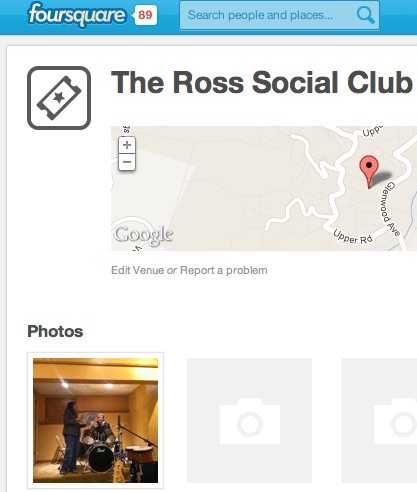
So this week a well known VC made the trek to my writing retreat in Marin, and we hung out in a room that until this year was a large storage closet behind my garage. I rethought the space, soundproofed it, added a hodge-podge of AV gear and musical instruments, and named the place the “Ross Social Club”  – on Foursquare, anyway. I haven’t really told anyone that I gave the place a name, but it was sort of an experiment – would anyone ever check in there besides me?

Now I chose that name for various reasons I won’t get into here (another story, one I’ll be glad to tell you over a bourbon). But I like being able to name a space on Foursquare, and it’s become a habit for me to “check in” whenever I actually use the room. It’s like  leaving a digital breadcrumb for me, a record of my new relationship to music (I’m learning to play the drums). A lot of friends hang out there too, often playing their own instruments or riffing on the whiteboards I’ve hung about the place. But  I don’t make it a habit to mention the room’s Foursquare doppelganger. It seems a bit … forced. And as far as I know, many of them don’t use the service.

On the same day I created the RSC on Foursquare (and probably because he asked me what I was doing on my phone), one fellow did check in. With some whimsy, he added a tip: “Try the wings.” It’d make you laugh if you’ve ever been there, trust me. Since then, in the past nine months, countless folks have been through the place, but only one other person has checked in.

Read More
9 Comments on Instrumenting People Into Location Services

SIGN UP FOR THE NEWSLETTER

Stay up to date on the latest from BattelleMedia.com

The Internet Big Five

As I work on the book, I’ve come to use a shorthand for five companies that I’ve determined are critical drivers of what kind of society we’ll be living in one generation from now. At the moment I’m focused on just Internet companies, though I also plan on looking at other categories, such as energy, food, and health.

My terminology has evolved in the past week from “the Five Horsemen” to simply “The Big Five.” I’ve got a few reasons for this. First, the Horsemen analogy is a bit negative (given it evokes the Four Horsemen of Apocalypse). Second, there’s a rather fun reference for the “big five” that has to do with personality traits (see this research, or this, for example). One goal of my book, which I should probably explain at a later date, is to tease out the essential character and philosophy – perhaps you could call it the personality – of each of these key Internet players. If corporations are people (in the US, anyway), I wonder what kind of people these companies might be?

I don’t think you’ll be surprised by my choice of the Big Five, but I do hope you’ll find my reasoning for their selection worthy. As you can see from the chart, the five are: Apple, Microsoft, Google, Amazon and Facebook.

Read More
50 Comments on The Internet Big Five

Facebook and the FTC Announce A Deal, For Now

The Federal Trade Commission and Facebook have come to terms on consumer privacy, an issue the FTC formally raised in an eight-count complaint earlier this year. Both sides have announced the pact in their own particular way.

On Facebook’s blog, CEO Mark Zuckerberg strikes a diplomatic tone with a dash of mea culpa.

“Overall, I think we have a good history of providing transparency and control over who can see your information,” he writes. “That said, I’m the first to admit that we’ve made a bunch of mistakes. In particular, I think that a small number of high profile mistakes…have often overshadowed much of the good work we’ve done.”

Read More
10 Comments on Facebook and the FTC Announce A Deal, For Now

The World In One Generation: Population Trends

In the vein of documenting how the world most likely will look one generate hence, my researcher and I have been taking a look at a number of key global drivers. One, of course, is how we govern ourselves (you can see posts on that topic here and here). Another is global population.

Working with data from the US Census Bureau and International Data Base, we’ve also overlayed some information from Internet World Stats, though for now, the fit is imperfect. Still and all, I found a lot to note in these reports. Thirty-odd years from now, the world is going to be a pretty different place, population wise. I’ve loaded the entire deck, created by my research manger LeeAnn Prescott, up on Slideshare. It has more detail, but I’m going to hit the main points in this post. First, to the basics. Here are population projections by world regions for 2013 (the year What We Hath Wrought comes out), and 2045 (roughly 30 years later):  

As you can see, Europe is shrinking, Asia and Africa are booming. Put another way:

Read More
8 Comments on The World In One Generation: Population Trends

Facebook and Commenting Systems: Still Some Open Questions

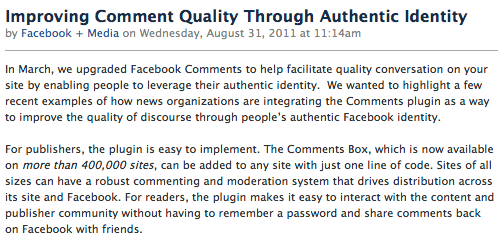
I’ve always been quite interested in commenting systems for the Independent Web, and when it came time to redesign this site, I chose to use Disqus, an independent company that is a leader in the space. Disqus has its detractors, but it has many more fans. The company has nearly 1 million sites using the services and is rolling out new features very quickly.

I did make a conscious choice to *not* use Facebook’s Commenting system. And while I could have justified the decision on pure features (I think Disqus still wins there), it’s more based on my belief in the Independent Web. I prefer to not have this valuable portion of my own domain controlled by a major identity platform with which I have some basic philosophical differences. (In short, I do not agree with the company’s stance on identity, among a few other things).

However, I was curious if others felt the same way. Apparently, the answer is no, if the numbers are any indication. Last night I asked this question on Quora: How many websites use facebook commenting? I’m curious if the service is growing, slowing, or flat?  I also emailed people I know at Facebook, and tweeted it. By this morning, Facebook gave me the answer (oddly, it did not show up on Google search, but that may because the two companies are retarded when it comes to sharing access to each other’s platforms. That’s a whole ‘nother story).

Read More
55 Comments on Facebook and Commenting Systems: Still Some Open Questions

The Problem and the Opportunity Of Mobile Advertising

I hate to pick on the good folks at TextPlus, because I like the service (and my kids do too). But my family recently had an experience that reminded me how stunted the advertising ecosystem remains in the (relatively) new world of apps.

Quite serendipitously, after that experience I had the pleasure of meeting the CEO of Gogii, the company behind TextPlus. More on what I learned from him in a moment. But first, to the problem.

TextPlus is a star in what I’ve come to call “AppWorld,” that Jobsian funhouse mirror universe of apps (TextPlus also on Android, where I’m told it’s growing faster than in iOS). Parent company Gogii is backed by Very Serious Venture Capitalists like Kleiner Perkins and Matrix Partners. Clearly, this is a horse that smart money is backing.

Read More
21 Comments on The Problem and the Opportunity Of Mobile Advertising

Whisperings of the Future Surround Us

Yesterday I met with Christopher Ahlberg, the PhD co-founder of Recorded Future, a company I noted in these pages back in mid-2010. Ahlberg is one of those rare birds you just know is making stuff that matters – a scientist, an entrepreneur, a tinkerer, and an enthusiast all wrapped into one.

He ran me through Recorded Future’s technology and business model, and I found it impressive. In fact, I’m hoping I can employ it somehow into my book research. And that conditional tense of “hoping” is the main problem I have with Ahlberg’s creation – it’s a rather complicated system to use. Then again, what of worth isn’t, I suppose?

Recorded Future is, at its core,  a semantic search engine that consumes tens of thousands of structured information feeds as its “crawl.” It then parses this corpus for several core assets: Entities, Events, and Time (or Dates). Recorded Future’s algorithms are particularly adept at identifying and isolating these items, then correlating them at scale. If that sounds simple, it ain’t.

Read More
8 Comments on Whisperings of the Future Surround Us

Kevin Kelly’s “What Technology Wants”

It took me a while, but I’ve finally finished Kevin Kelly’sWhat Technology Wants,” first published last year and now out in paperback. Befitting a tome that took five or so years to write, Kevin’s book is not the kind of work that is easily digested – at least for me.

But that’s not to say it’s not worthy. It most certainly is. I worked with Kevin for five wonderful years as a co-founding editor of Wired, and throughout that tumultuous period (1992-1997) Kevin never ceased to surprise me – both with stories of his extraordinary life (after converting to Christianity whilst wandering in the Middle East, for example, he bicycled across the US under the self imposed belief that he would die at the end of his trip), as well as with his boundless curiosity. I was very young when we worked together, to say he had a profound impact on how I understood the practice of writing is an understatement. Together we edited every single word in more than fifty issues of Wired, after all.

With those caveats declared, then, let me get to the book at hand. Some non-fiction books present themselves as lectures or arguments. And still others are very clearly the manifestation of the author’s own unscratchable itch. What Technology Wants is both of these, and more. In the introduction, Kevin pretty much sums it up: “What was (technology’s) essence? If I didn’t understand the basic nature of technology, then as each new piece of it came along, I would have no frame of reference to decide how weakly or strongly to embrace it.”

Read More
20 Comments on Kevin Kelly’s “What Technology Wants”

You Are The Platform

A funny thing happens to me after each Web 2 Summit – I tend to curl up for a week or two and shut down my idea receptors. It takes a ton of output to curate the show, and then running it for three straight days is rather like running an intellectual and social marathon. You’re “on” the whole time, scrambling backstage, pretending to have it together onstage, greeting amazing minds, cheering them on, delivering what I hope will be thought provoking interlocution, and, of course, remembering to thank everyone for giving so generously of their time and treasure.

So when people ask me what I thought of the show, or what the key themes were, I usually have something of a blind spot. I can remember everything up to the start of the event – all the preparation, preproduction interviews, the endless research, etc. But once we kickoff (in this case, with an interview with Sean Parker), it goes kind of black. My next memory is usually the final cocktail party on day three. I know my Dad and my wife are usually there, and I know I have a fine bourbon in my hand. And I’m happy. And I want to sleep.

Which I’ve done a lot of these past two weeks. But this last show was too rich to not review a bit, in particular for themes that should inform our collective decisions as we move our industry forward. In this post and I hope in others this Fall, I hope to outline some of those themes.

Read More
16 Comments on You Are The Platform

Video as Grammar: The Supercut

As early as 2003, which was the first year I began writing this site, I wrote about the idea of “video as grammar.” By this I meant (and mean) that I foresaw a day when our culture communicated with itself using video much as we currently use text.

In order for this to happen, a number of things had to fall in place. First, we needed tools that allow for quick and easy “video processing” – we need the Microsoft Word for video.

Second, we need access to a large “vocabulary” of video that we could annotate, cite, cut, paste, and repurpose.

Read More
3 Comments on Video as Grammar: The Supercut