
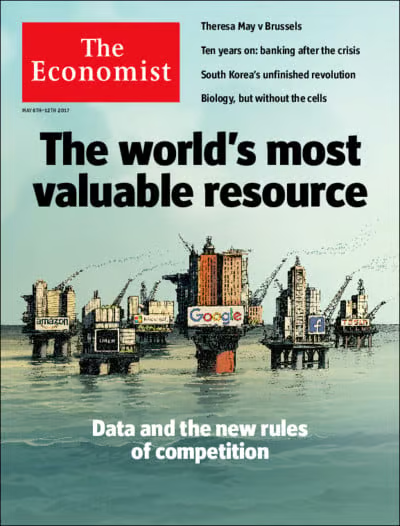
“Data is the new oil.”
It’s the metaphor that won’t die, though for the next little bit, I’ll do my part to advance its expiration date. Yesterday came news that Google purchased the entire data corpus of Spirit Airlines, which is selling its assets in a bankruptcy process. Google isn’t planning on launching an airline – instead, it believes Sprit’s data will help train more capable AI models. Cementing the role AI plays in reviving the “data is oil” narrative, Google won the auction over Mercor, a firm that pays contractors to train AI systems.
The idea that corporate data – emails, Teams messages, legal and pricing policies, 34 years’ worth of Office and Google Workspace documents – is worth *anything* is relatively novel. But the argument used to justify the deal’s $10 million price tag- that data is an economic asset just like oil – is not.
“Data is the new oil” became a mainstay of tech punditry more than two decades ago, but gained canonical status when The Economist gave it a cover treatment back in 2018. The Economist’s coverage made numerous salient points, but omitted data’s most important characteristic: Unlike oil, data is non-rivalrous. Because it is a digital asset, data doesn’t vanish after one use. Using it doesn’t diminish its value – in fact, just the opposite can be argued.
By purchasing Spirit’s data, Google has enclosed decades’ worth of information about how an industry sector prices, markets, and engages with vendors, customers, and employees. No one else will benefit from that information – and many of us may well be harmed. After all, Google runs a massive marketplace for flight information, and it could use Spirit’s proprietary data to tune that marketplace for its own gain. That alone justifies why Google was willing to pay $10 million for Spirit’s digital carcass – but I’d argue it was worth far more.
I’m not a bankruptcy lawyer, but I am deeply interested in the legal concept of public goods, an economic concept foundational to democratic processes. Public goods are non-rivalrous by nature – they are available to all, and their use by one person does not prevent use by others. Public goods are usually created through government, which determines that some things in society – clean air and water, military defense, street lighting, lighthouses – are too important to be enclosed by private capital.
An argument I’m interested in exploring is how we might apply the concept of public goods to data assets. When a company is public – as Spirit was prior to its demise – why shouldn’t the public (or at least the public shareholders) have a stake in the value of its data? Clearly there is massive potential to be excavated in the archaeological remains of a 17,000-person company that existed for more than 30 years. Now that we have AI systems capable of making sense of such a trove, why consign its insights to whichever private company is willing to pay the most in a bankruptcy auction? Is there not a public good to consider?
This kind of thinking feels a bit counterintuitive, but as I’ve argued elsewhere, we’re doing a terrible job if understanding the true value of data in society. If you’re working in this space, I’d love to hear from you.
—