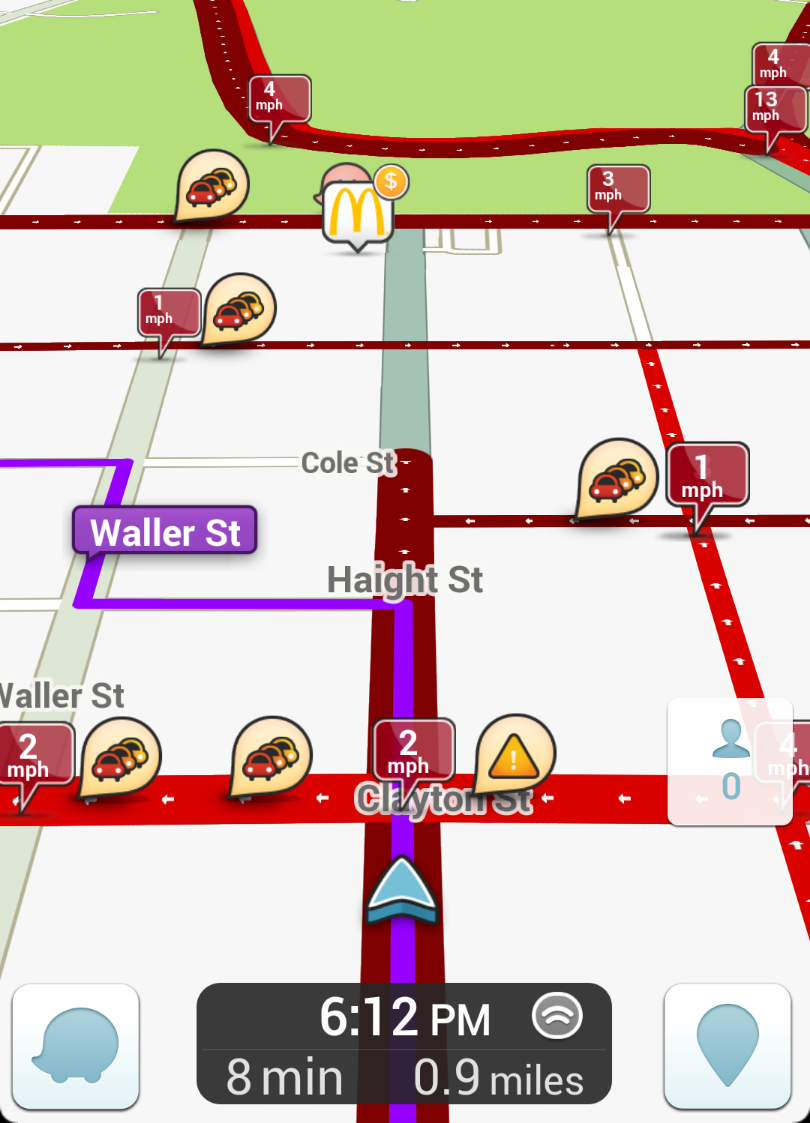
A couple of weeks ago my wife and I were heading across the San Rafael bridge to downtown Oakland for a show at the Fox Theatre. As all Bay area drivers know, there’s a historically awful stretch of Interstate 80 along that route – a permanent traffic sh*t show. I considered taking San Pablo road, a major thoroughfare which parallels the freeway. But my wife fired up Waze instead, and we proceeded to follow an intricate set of instructions which took us onto frontage roads, side streets, and counter-intuitive detours. Despite our shared unease (unfamiliar streets through some blighted neighborhoods), we trusted the Waze algorithms – and we weren’t alone. In fact, a continuous stream of automobiles snaked along the very same improbable route – and inside the cars ahead and behind me, I saw glowing blue screens delivering similar instructions to the drivers within.
Category: Policy
Robert Reich: “Saving Capitalism” From Itself
Robert Reich’s Saving Capitalism: For the Many, Not the Few is a readable rant that – should you disagree with Reich’s central premise – will elicit eye-rolls and summary dismissal. But while his well-known political ideology (he served as Secretary of Labor under Clinton) is on constant display, I found Reich’s book both timely and important.
I am drawn to any work that posits a better way forward, and as you might expect, I agree with Reich far more often than not. You have to be willfully ignorant to pretend our current economic system is equitable (Reich argues we’re in the “second Gilded Age“) or capable of creating long-term increasing returns. And while many in our industry cling to libertarian fantasies in which technologic silver bullets solve our every social need, back here on earth we need to do better than pine for the singularity. Fixing income inequality and the loss of the middle class requires hard policy choices and a re-framing of the problems at hand.
Reich’s compact book lays out a strong prescription for what he feels is ailing our capitalist system. Anyone in tech should pay attention: Reich lumps the tech elite right alongside bankers, big pharma, and agribusiness as the new monopolists, and argues that if our capitalist society is to truly prosper, some pretty fundamental changes have to occur in both our economic policy as well as the structure, practices, and purpose of the companies we build.
Read MoreApp Stores Must Go
2014 was the year the industry woke up to the power of mobile app installs, and the advertising platforms that drive them. Facebook’s impressive mobile revenue numbers – 66% of its Q3 2014 revenue and growing – are a proxy for the mobile economy at large, and while the company doesn’t divulge what percentage of that revenue is app install advertising, estimates range from a third to a half – which means that Facebook made anywhere from $700 million to more than a billion dollars in one quarter on app install advertising. That’s potentially $4 billion+ a year of app installs, just on Facebook. Yow. That kind of growth is reminiscent of search revenues a decade ago.
But as I’ve written before, app installs are only the beginning of an ongoing marketing relationship that an app publisher must have with its consumer. It’s one thing to get your app installed, but quite another to get people to keep opening it, using it, and ultimately, doing things that create revenue for you. The next step after app install revenue is “app re-engagement,” and the battle to win this emerging category is already underway, with all the major platforms (Twitter, Yahoo, Google, Facebook) rolling out products, and a slew of startups vying for share (and M&A glory, I’d wager).
Whither the Public Commons? Enter The Private Corporation
(image) From time to time a piece reminds us that we are in a slow, poorly articulated struggle over what we hold as a public commons. That was the case with Vanity Fair’s Man and Uber Man, a profile of Uber’s Travis Kalanick by Kara Swisher. Swisher deftly captures Kalanick’s combative approach in prosecuting what he calls Uber’s “political campaign” to beat established regulated markets in transportation, a campaign he believes he must win “98 to 2” – because the candidate is a product, not a politician. In short, Uber can’t afford to win by a simple majority – this is a winner takes all scenario.
This gives me pause, and I sense I’m not alone. On the one hand, we praise Uber for identifying a huge market encumbered by slow moving bureaucracy, and creating a service markedly better than its alternatives. That’s what I’ve called an “Information First” company. On the other hand, we worry about what it means when something that was once held in public commons – the right to transportation – is increasingly pushed aside in favor of private alternatives. Messy as it may be, our public transportation system is egalitarian in its approach, non-profit at its core, and truly public – as in, bound to the public commons through government regulation.
Read MoreA Big Day For The Internet
Today scores of big companies are taking symbolic action to defend the essential principles of an open Internet, and I support them. That’s why, on your first visit here today, you’ll see the “spinning ball of death” up on the right. For more information about the Internet Slowdown, head here.
Viacom v. Cable One: A Foreshadowing of Things To Come in The Battle for the Open Web?

So it’s come to this.
We’re all familiar with disputes between cable providers and their content partners – it happens all the time. One party claims the other party is demanding too much in a carriage negotiation, and in retaliation, the offended party pulls the programming in dispute. It might be the programmer who refuses to allow its content to run, or the cable company who refuses to put it on the air. The last big one I recall was between Time Warner and CBS back in the Fall, when many major markets looked to be losing football coverage just as the season was starting.
Read MoreElse 4.28.14: F*ck Policy, Except When I Care About The Outcome
To subscribe to Else via email, click here.
Goodbye, Net Neutrality; Hello, Net Discrimination : The New Yorker
Read MoreThe Next Vegas Will Be A City That Lets You Truly Disappear – If Only For A While
(image) My daily reading took me to two places today – to Compton, California, well-known for its crime to anyone who grew up in LA (as I did), and to this NYT piece, which muses that the city, once the place we went to disappear, is likely to be the first place where anonymity is no longer guaranteed. (Not coincidentally, Pell found both pieces as well in his excellent NextDraft).
The Compton story informs us that for one month in 2012, the LA police department – not exactly a bastion of trustworthy behavior – surveilled the troubled district of Compton from the air, creating a 24-7 record of everything that was “publicly” viewable from the air. This piece chills me on a number of fronts: average citizens do not presume they are being watched from above, first of all. Secondly, do we want a society where such surveillance is presumed (read a bit of science fiction if your answer is yes)? And thirdly, this “wide net” of proactively collected data creates a record of actions that can be “rewound” and used as evidence after the fact – opening a raft of unsettling questions. It reminds me of one of Eric Schmidt’s creepier utterances (also known as the “nothing to hide” argument): “If you have something that you don’t want anyone to know, maybe you shouldn’t be doing it in the first place.”
The debate around privacy is nuanced and complex, I don’t intend to litigate it here. But as I read the Compton piece, it struck me that this particular genie is fast escaping the bottle. The Compton experiment was conducted using an airplane, but if you think police departments in major cities aren’t adopting far less expensive drone-based programs, I’ve got a bridge in Brooklyn to sell you…
Read MoreElse 3.10.13: Satoshi, Snowden, Google, And The Meaning of it All
The past week spun with controversy and breaking news around many of our society’s most interesting conversations: The elusive founder of bitcoin was identified, or perhaps not, Edward Snowden popped up at SXSW (by video, of course) and submitted testimony to the EU, the Aereo case is on its way to the Supreme Court (and launched in Austin at SXSW, of course), and in the end, we all long for something more. To the links….
The Face Behind Bitcoin – Newsweek The week’s most sensational story, which created a backlash worthy of the story’s claim.
Read MoreTraffic of Good Intent: We Beat Fraud By Working Together
Earlier this year I wrote a post titled It’s Time To Call Out Fraud In The Adtech Ecosystem. The overwhelming response to that riposte led to a lunch at this year’s IAB annual meeting, which then led to the formation of the Traffic of Good Intent task force (TOGI), an IAB-sanctioned working group composed of leaders from nearly every major player in the media and adtech industry. We’ve made a lot of progress since our first informal luncheon meeting nine months ago – I think the issue of fraud is now a top priority in our industry, and we continue work on best practices, solutions, and education. Today marks a milestone for our industry, the release of two white papers. Both are clearly written and intended to catalyze our progress to date.
Understanding Online Traffic Fraud gives a broad overview of the problem, laying out definitions of non-human traffic, and lays out half a dozen reasons you should give a sh*t. For me, the money quote is this: “Failing to root out traffic fraud funds criminal activity and supports organized crime.” Because as an advocate for publishers, that’s what fraud is: it’s stealing. It’s taking money and value out of the pockets of publishers, and putting it into the pockets of criminals. Along the way, any number of intermediaries also make money, and in the short term, they may be incented to continue to do so. We have to change that.
Read More